

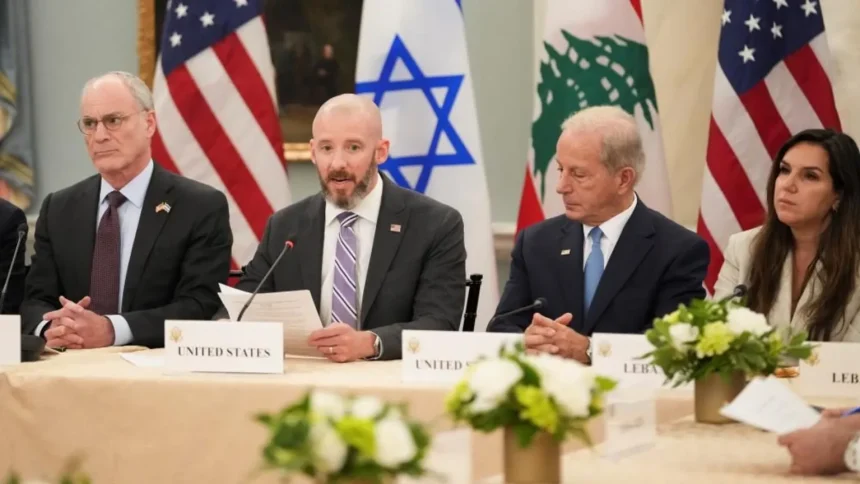
While the tactical details of the newly announced US-mediated conditional ceasefire are being heavily scrutinized by military analysts in Beirut and Tel Aviv, global financial networks have already made their first decisive moves. The structural intersection of conflict and commerce means that any shift in West Asia instantly recalibrates risk premium valuations across the globe.
On Thursday, June 4, 2026, energy and commodity markets reacted with immediate volatility to the joint statement released by the US State Department. The news that Israel and Lebanon have agreed to a framework for a cessation of hostilities—completely contingent on Hezbollah’s total evacuation from southern Lebanon—provided a sudden, much-needed safety buffer for international shipping lanes and supply chains.
PBS
Energy Markets Reacting to Major Geopolitical Shifts. Source: RonFullHD / Getty Images
Crude Oil Pullback: Brent Drops Below $97
The most immediate and visible indicator of easing regional anxieties occurred in the energy sector. Following the official confirmation of the Washington breakthrough, Brent crude futures slid by over 1 percent, settling at $96.90 per barrel on Thursday morning.
This downward adjustment represents a significant cooling-off period. Crude prices had been trading at elevated levels due to structural fears surrounding the broader conflict that broke out earlier this year. For energy traders, the conditional agreement signals a potential pause in the destructive cycle of infrastructure targeting that has threatened regional production capacity over the past four months.
However, market analysts warn that this pullback is fragile. Because the truce hinges entirely on the behavioral compliance of a non-state militia, commodity desks are keeping their protective hedges in place, treating this drop as a temporary reprieve rather than a permanent structural reset.
PBS
The Strategic Prize: Reopening the Strait of Hormuz
To fully grasp the economic stakes of these Washington talks, the Israel-Lebanon agreement must be viewed as one piece of a much larger diplomatic puzzle engineered by the Trump administration. The ultimate macro objective for global trade is not just stabilizing the Blue Line border, but convincing Tehran to formalize a broader diplomatic framework.
Ever since hostilities intensified, maritime shipping has faced immense friction, particularly around critical choke points. The White House’s primary economic goal is leveraging this localized border truce into a long-term agreement to fully reopen the Strait of Hormuz and cement the tentative regional understandings established in April.
“No tangible progress can be sustained globally if the localized theater remains active. Any direct expansion of strikes on Beirut will trigger a full-scale resumption of the wider maritime blockade.”
— Official warning from Iranian Foreign Minister Abbas Araghchi regarding the interconnected nature of the peace talks.
Because Iran has consistently tied its cooperation on shipping access to the cessation of operations inside Lebanon, this conditional deal serves as the ultimate litmus test for global trade stabilization.
Macro Economic Tracking: Sector Responses to the Truce
The financial ripple effects of the conditional ceasefire extend far beyond oil futures. Different sectors of the global economy are reacting based on varying levels of risk exposure:
Economic Sector Immediate Market Reaction Underlying Driving Mechanism Mid-Term Vulnerability Point
Maritime Shipping Maritime insurance premiums for East Mediterranean transit dropped by roughly 8 percent. Reduced immediate threat of localized drone and short-range missile strikes targeting commercial ports. Continued deployment of naval blockades and unresolved maritime boundary disputes.
Sovereign Debt Lebanese dollar-denominated bonds experienced a modest 3-point rally from historic lows. Market optimization based on the potential return of state authority and eventual economic reconstruction. Severe domestic inflation and extreme reliance on foreign military logistical aid.
Defense Equities Major Western defense contractor stocks flattened out after a multi-week upward rally. Speculation that localized de-escalation might slow down the immediate pace of emergency munitions procurement. Persistent security demands along Eastern European and Pacific operational theaters.
A Sovereign Paradox: Trading Without a Key Player
The fundamental complexity keeping corporate risk assessors awake at night is the structural paradox of the negotiation itself. This agreement was drafted, debated, and signed exclusively between the official, sovereign governments of Israel and Lebanon—two states that do not even maintain formal diplomatic ties.
Yet, the actual implementation of the deal relies entirely on Hezbollah, an armed political and military entity that was completely absent from the negotiating table in Washington. While the Lebanese embassy has signaled that the group has privately agreed to a mutual cessation of attacks, prominent figures within the militia have publicly rejected any framework that trades a southern withdrawal for structural limitations.
For international businesses looking to reinvest in East Mediterranean logistics or infrastructure, this creates a profound legal and operational dilemma. Contracts can be signed with the state framework in Beirut, but operational security on the ground remains dictated by a faction outside that framework. Until the Lebanese Armed Forces demonstrate an absolute monopoly on physical force within the newly designated “pilot security zones,” the economic promise of this ceasefire will remain confined to trading screens and diplomatic press releases.