

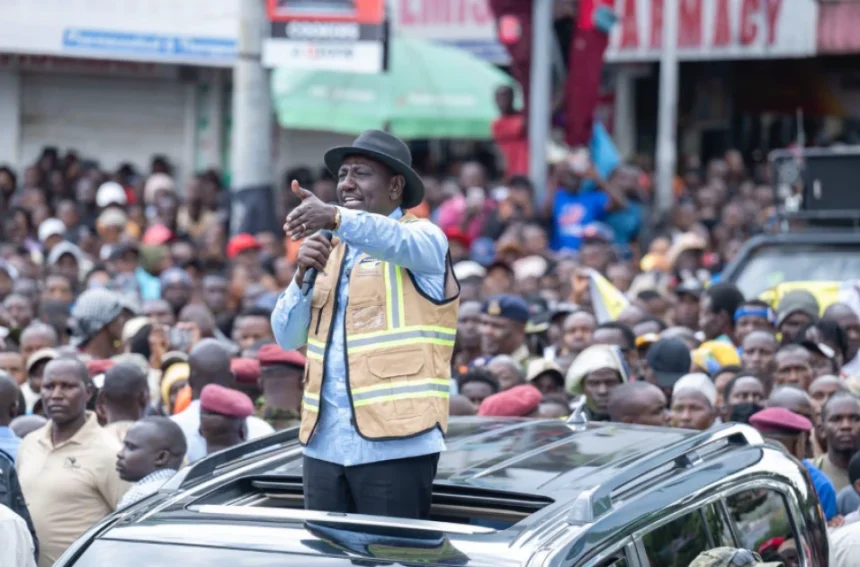
In the intricate dance between a government and its citizens, few things are as fundamental—or as fragile—as clear communication. A recent vow by President William Ruto to “dual the Nairobi-Thika Road” has become a stunning case study in how that communication can spectacularly break down, transforming a potential infrastructure announcement into a national punchline. The immediate, viral reaction of puzzlement and mockery wasn’t simply about a road; it was the sound of millions of citizens hitting a collective wall of cognitive dissonance. They were presented with a promise that directly contradicted a massive, daily lived experience: the Thika Road is, and has been for over a decade, a magnificent superhighway.
This episode transcends transportation policy. It reveals a deep and growing chasm between political messaging and public perception. It’s a story about how a government’s internal logic—its plans, its jargon, its regional targeting—can completely misfire when broadcast to a nation. The Thika Road saga is not an isolated gaffe; it is a powerful symptom of a chronic communication disorder within modern governance, where the message sent is rarely the message received, and the cost is paid in public trust.
Decoding the Jargon: Why “Dual” Didn’t Mean “Dual”
To understand the failure, we must first move past the literal meaning of the words. Within the corridors of the Ministry of Transport and Infrastructure, the term “dual the Nairobi-Thika Road” almost certainly had a specific, technical meaning. It was likely shorthand for a complex bundle of projects known internally, such as:
The Thika Town Bypass or Extension: Dualling the remaining congested stretches beyond the current superhighway terminus.
A Major Intelligent Transport Systems (ITS) Overhaul: Adding digital traffic management, smart lighting, and monitoring to the existing road.
Complementary Infrastructure: Building the long-promised non-motorized transport corridors, commuter rail links, or last-mile connectivity alongside the highway.
This is smart, forward-thinking policy. However, the communication to the public was reduced to a single, fatally flawed verb: “dual.” This is the critical error. To the average citizen, “dual” has one meaning: to convert a single-carriageway road into a dual-carriageway. Applying that term to Africa’s equivalent of an American interstate was not just inaccurate; it was illogical. The government was speaking in dense, internal policy acronyms, while the public was listening in plain Kiswahili and English. The translators had gone home.
The Trust Deficit: Why Citizens Default to Cynicism
The public’s reaction was not merely confusion; it was instant, widespread cynicism. This is the second layer of the crisis. In an environment where citizens have been conditioned by years of recycled promises, grandiose launches of “new” versions of old projects, and a perceived lack of accountability, the benefit of the doubt is in short supply.
When a statement contradicts a known truth, citizens don’t assume a complex technical meaning. They default to one of three cynical conclusions:
The Leadership is Out of Touch: “Do they even drive on this road they are promising to build?”
It’s a Political Distraction: “This is just noise to cover up for the high cost of living.”
It’s a Financial Red Flag: “Where are the billions for this ‘new’ project coming from, and who will benefit?”
The Thika Road promise, by clashing with reality, activated all these suspicions at once. It didn’t generate hope; it generated memes. It didn’t inspire confidence; it inspired comedians. The government lost control of the narrative within minutes, not because their underlying plan was bad, but because their chosen words were so catastrophically wrong for the audience.
The High Cost of Miscommunication
The fallout from such episodes is real and damaging. It erodes the capital a government needs to enact difficult but necessary reforms. If the public is laughing at your flagship infrastructure announcements, how will they react to complex tax proposals or austerity measures? It also wastes tremendous political energy. Instead of debating the merits of extending transport links into growing counties, the nation spent days explaining to its own government that a superhighway already exists.
Furthermore, it undermines genuine achievement. When everything is announced as a revolutionary new project, the public becomes numb. The truly new and transformative gets lost in the noise of repackaged old news. Citizens start to wonder: if they can’t accurately describe what’s already built, how can we trust their vision for what’s to come?
The Road to Repair: A New Communication Contract
Fixing this requires more than just better speechwriters. It requires a fundamental shift in how the government views public communication.
Precision Over Puffery: Announcements must be geographically and technically precise. “We are launching the construction of a new dual carriageway from Kenyatta University Roundabout to Thika Town” is unambiguous. “We are dualling Thika Road” is not.
Acknowledge the Past: Smart communication builds on shared reality. A simple line—”Building on the success of the existing Thika Superhighway, we will now extend its benefits…”—would have anchored the new promise in truth, not fantasy.
Use Visuals, Always: In the digital age, no major infrastructure promise should be made without a map, a diagram, or a CGI render. A single image would have instantly clarified that the promise was about an extension, not the existing road.
Respect the Public’s Intelligence: The Kenyan public is informed, tech-savvy, and has a long memory. Communication must respect that. They are not passive recipients of slogans; they are active analysts of information.
Conclusion: Paving Over the Potholes in Public Trust
The Nairobi-Thika Superhighway remains an engineering marvel. The government’s underlying plans to improve connectivity beyond it may be sound policy. But between the concrete and the citizen stands the fragile bridge of communication. The Thika Road saga shows what happens when that bridge collapses.
Rebuilding it requires humility, precision, and a relentless respect for the facts on the ground—literally. For a government seeking to build a legacy, the first and most important project might not be made of steel and asphalt, but of clarity, consistency, and truth. The next time a major promise is made, the test will be simple: does it clarify, or does it confuse? The nation, still chuckling from the last one, will be watching closely.