
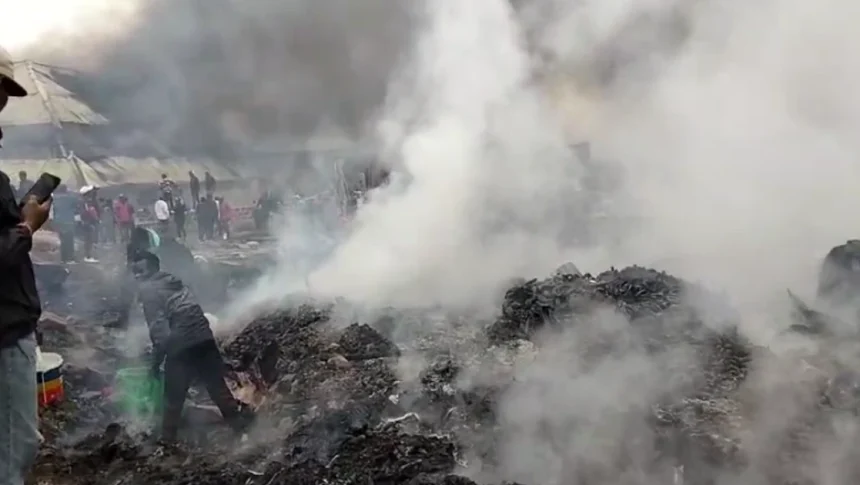
As thick columns of gray smoke continue to rise from the scorched remains of Gikomba Market, hundreds of small-scale business owners are sitting beside heaps of charcoal, staring blankly at what used to be their sole source of livelihood.
The Eastleigh Voice
The latest 4:00 a.m. inferno, which raged for nearly 10 intensive hours before multi-agency emergency forces managed to contain it, completely flattened several expansive wings of East Africa’s largest open-air hub. From the fish side and Gorofani estate to specialized stalls like Kwa Ma Bags, Kwa Mbao, and Kwa Uniforms, years of personal savings, family investments, and active bank loans vanished into ash in a single morning.
Standard Newspaper
+ 1
For the thousands of affected traders, the tragedy is not just a statistical loss—it is a sudden, crushing end to their economic survival.
The Eastleigh Voice
The Panic Calls: “By the Time I Arrived, the Flames Had Consumed Everything”
The nightmare began in the dead of night, forcing traders to race against time across Nairobi in a desperate bid to rescue their properties. For most, the realization of the damage hit long before the sun came up.
Lydia Aurelia’s Story: “Our Monday Stock is Gone”
Lydia Aurelia, a second-hand clothes retailer whose business supported her family for years, sat in shock on a pile of debris as she recounted her frantic morning:
The Eastleigh Voice
“I received a call at 2:00 a.m. and was told there was a fire outbreak but they were trying to put it off. At around 5:00 a.m. I was called again and told it had been successfully put off. But as we speak, we have no job. Everything is gone with the fire. The clothes we were to sell on Monday have all been burnt.”
Aurelia explained that the timing could not have been worse. Traders typically stack up on fresh, high-value bales over the weekend in anticipation of heavy Monday morning wholesale foot traffic.
“We do not have anything left. We have not saved anything. Those who depend on the market to feed their children and pay for the medical care of their parents have nowhere to turn to. I wish we would have been told to move away the way shoe sellers were told. You had given us a six-month window and we are still within that period. We are now in big problems; we have nowhere to go.”
[ 2:00 AM: First Alert ] ──> Traders told blaze is being managed
│
▼
[ 5:00 AM: Second Alert ] ──> Told fire is out, but arrivals find total ash
│
▼
[ The Reality ] ──> Monday morning stock vaporized; zero capital saved
“Years of Hard Work Disappeared in Hours”
A short distance away, Zakaria Mukami stood paralyzed outside the smoking shell of his retail footwear empire. Mukami operated multiple shoe shops within the market, building a loyal customer base over a decade of intense physical hustle.
The Eastleigh Voice
With tears in his eyes, he described the helpless feeling of watching the massive fire rapidly jump from one wooden stall structure to the next, completely blocking off any safe access paths.
The Eastleigh Voice
“I was called at around 3:00 a.m. and was told Gikomba was on fire, and I immediately rushed here,” Mukami whispered, visibly overwhelmed by the destruction. “The fire was simply too huge, and it was not possible to salvage anything. Please help me.”
The Eastleigh Voice
The Non-Operational Fire Station: Traders Demand Answers
Beyond the immediate grief, deep frustration and anger are boiling over within the Gikomba community. Traders are aggressively questioning why localized emergency infrastructure failed to neutralize the threat when the first alarms were raised at 4:00 a.m.
The Star
Many pointed out the bitter irony of the newly constructed Gikomba Fire Station. Despite sitting directly adjacent to the trading hub, merchants claim its localized assets were painfully lagging during the critical initial breakout windows.
“They constructed a fire station right here, but it has never been fully operational,” one local clothing vendor lamented. “If we had active, fully geared trucks stationed inside this zone, they would have suppressed the flames before they jumped into Gorofani and Bondeni. Instead, we had to wait for outside reinforcement while watching our shops melt.”
What Lies Ahead for Gikomba’s Victims?
The Star
With the Kenya Red Cross confirming that 17 casualties were treated on-site for minor burns and smoke inhalation, the immediate physical danger has passed—but the psychological and financial trauma is just beginning.
As the Directorate of Criminal Investigations (DCI) launches a formal inquiry into the exact trigger of the blaze, the affected traders face a steep uphill battle. Deprived of insurance coverage and stripped of their physical assets, the market community is collectively appealing to both the national government and the Nairobi City County leadership for emergency financial grants and immediate tax relief to help them construct temporary stalls and start over from absolute zero.