
The Conversation That Never Ends
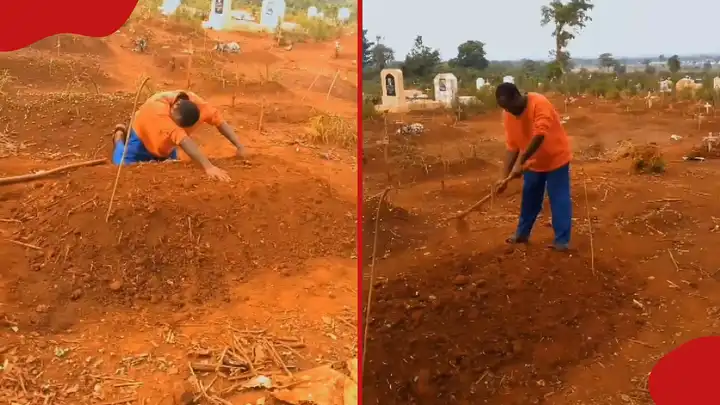
In the quiet of a cemetery, a son’s tearful whisper, “Nakupenda Mama,” does not vanish into the air. It travels along an invisible, unbreakable line—a connection that was formed in the womb, forged through a lifetime of care, and proven to be stronger than death itself. The viral video of this man tending his mother’s grave captures more than a moment of grief; it is a powerful testament to the enduring, active nature of a mother’s love. This love does not reside in the grave; it emanates from it. It is not a memory locked in the past, but a living force that continues to guide, comfort, and shape the son who stands before the stone. In his tears, we see not just the pain of loss, but the evidence of a bond that remains vibrantly, painfully alive.
This challenges a common, linear view of loss—that a person dies, and the relationship ends. What we witness in this man’s devotion suggests a different truth: the relationship transforms. The physical presence is gone, but the spiritual and psychological presence of the mother becomes more concentrated, more symbolic, and in many ways, more powerfully felt. The grave becomes a focal point, an altar where the ongoing relationship is honored and sustained. The son is not visiting a place of death; he is visiting a sanctuary of ongoing connection.
The Architecture of an Eternal Bond
How does a love survive the death of the one who gave it? The bond between a mother and child is the foundational architecture of human experience. It is built from elements that are, by their nature, immortal.
The Blueprint of the Self: A mother is our first mirror. Our sense of self, our capacity for trust, and our template for all future love are imprinted by her early care. Her voice becomes our inner voice of comfort; her touch, our innate sense of safety. This psychological blueprint is permanent. When she dies, she does not leave us; she becomes woven into the very fabric of our psyche. The man crying at the grave is, in part, crying for a part of himself that feels lost—because she was the architect of that self. Her love is the foundation upon which he still stands.
The Living Legacy of Values and Lessons: A mother’s love is not merely emotional; it is instructive. Through her actions, sacrifices, and words, she instills values—resilience, kindness, integrity, faith. These are not buried with her. They live on as her active legacy in our choices. When the son carefully tends the grave, he is enacting the values she taught him: respect, duty, and honoring one’s family. In every moral decision he makes, in every act of kindness he performs, her love is still active, still guiding. She is not a ghost from the past, but a moral compass for the present.
Love as an Unseen Current: Modern physics speaks of the conservation of energy—that energy cannot be created or destroyed, only transformed. Love may be the emotional corollary. The immense love a mother pours into her child does not evaporate at her death. It is conserved within the child, becoming a permanent source of strength and identity. This stored love is what the son draws upon in his grief. It is why he feels her absence so acutely—because her presence, in the form of this conserved love, is so deeply embedded within him. His visit is an act of tapping into that reserve, of reaffirming its existence.
The Two-Way Street of Sustained Connection
The connection is not a one-way memory. It is a dynamic, two-way relationship that the living child actively maintains. The grave visit is a key ritual in this maintenance, but it is only the most visible part.
The Child’s Role: Active Remembrance: By visiting the grave, speaking to her, living by her values, and sharing her stories, the child keeps the mother’s spirit active in the world. He becomes the curator of her memory and the executor of her lasting influence. His life becomes the primary vessel of her ongoing presence. In loving her still, he gives her love a place to reside.
The Mother’s Role: Posthumous Presence: From her new state, the mother’s love operates differently. It becomes a source of intuitive guidance. Many people report feeling a mother’s presence in moments of crisis or decision, a sudden sense of what she would say or do. This is often described as a “sign”—a song on the radio, a found object, a vivid dream. These are not mere coincidences to the grieving; they are communications along the unbroken bond, interpreted by a heart trained to understand her language. Her love becomes a protective, guiding light that the child learns to perceive in subtler ways.
Finding the Connection Beyond the Cemetery
While the gravesite is a powerful focal point, the enduring bond is nurtured in countless daily ways. We strengthen this eternal connection by:
Living the Legacy: The most powerful tribute is to incarnate her best qualities. Be the patience she showed, practice the generosity she taught, fight with the strength she embodied.
Sacred Rituals: Create personal traditions—cooking her signature dish on her birthday, listening to her favorite music, or writing her an annual letter detailing the year’s events and your feelings.
Conversational Memory: Keep talking about her. Share anecdotes with family and friends, especially the younger generation who never met her. In the telling, she comes alive again in the communal imagination.
Conclusion: Love Is the Only Thing That Doesn’t Die
The man at his mother’s grave, in his profound sorrow, is actually demonstrating the greatest triumph of the human heart: the ability to maintain a bond that physical laws say should be broken. His tears are the proof of love’s victory over death. They water the invisible, enduring thread that still connects him to her.
He teaches us that we do not “get over” the loss of a mother. We learn to live within the new geography of a relationship that has moved from the physical to the eternal. The love does not end; it deepens. It becomes more reflective, more grateful, more conscious. In the end, the grave is not a period but a comma. The sentence of love continues, written now in the choices of the living, guided by the unseen, unfading hand of the mother who loved us first, and whose love, we discover, was the one thing she truly could give us forever.