

Modern warfare is no longer defined purely by the sheer volume of artillery shells fired or the number of troops deployed on a frontline. Instead, the fifth year of the Russia-Ukraine conflict has evolved into a hyper-targeted war of industrial attrition, where victory belongs to the side that can accurately identify and dismantle the adversary’s micro-component manufacturing bottlenecks.
Defence Matters
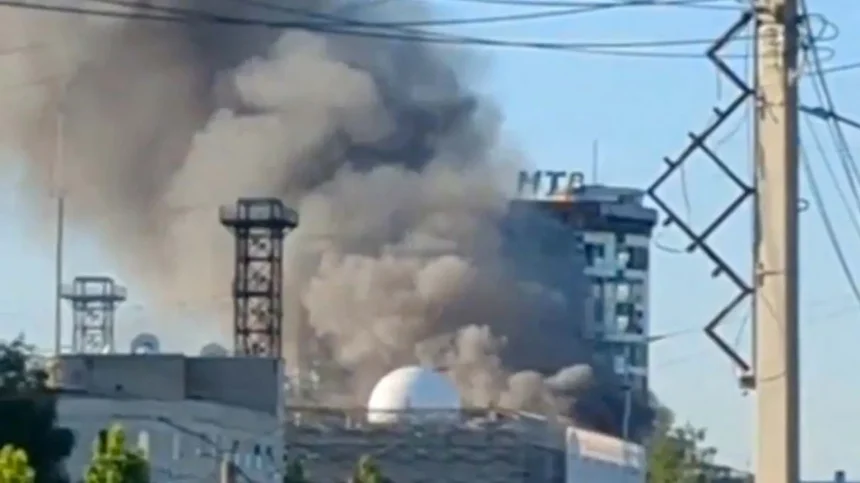
On Wednesday, June 10, 2026, the strategic reality of this shift was laid bare. Ukrainian President Volodymyr Zelenskyy officially confirmed a massive, deep-penetration strike campaign utilizing Ukraine’s newest domestically produced weapon system: the FP-5 “Flamingo” cruise missile. Slipping through thousands of kilometers of Russian airspace, these advanced projectiles struck a catastrophic blow against the VNIIR-Progress defense electronics plant in Cheboksary, deep within Russia’s Chuvash Republic.
Al Arabiya
+ 2
Rather than hitting a traditional ammunition depot or logistics railhead, Ukrainian planners targeted the exact birthplace of the specialized micro-electronics that allow Russia’s long-range drone and missile fleets to find their targets. This alternative deep-dive analyzes the sophisticated technology behind the strike, the engineering marvel of Ukraine’s new cruise missile, the systemic failure of Russian domestic air defenses, and the compounding economic damage dealt to the Kremlin’s energy network.
Defence Matters
Target Breakdown: Why VNIIR-Progress is Russia’s Ultimate Technical Choke Point
To understand the immense strategic value of the June 10 strike, one must look past the outer concrete structures of the VNIIR-Progress complex and examine the microchips, testing stands, and clean rooms inside. The facility, which operates under the umbrella of the specialized ABS Electro group, is highly sanctioned by the United States, the European Union, and Ukraine—and for good reason.
The Kyiv Independent
The factory is the sole primary manufacturer of the “Kometa” anti-jamming satellite navigation antenna module.
[Traditional Drones] ─────> Vulnerable to GPS Spoofing ───> Disrupted / Misses Target
[Kometa-Equipped Drones] ─> Filters Electronic Jamming ──> Successfully Hits Target
Early in the conflict, Russian Shahed-type suicide drones relied on basic four-element satellite antennas, which were highly vulnerable to Ukrainian electronic warfare (EW) jamming and spoofing systems. To bypass these defensive grids, Russian engineers evolved the Kometa module into highly complex 8-element, 12-element, and eventually 16-element arrays. These modules act as an electronic shield, allowing Shahed drones, Iskander-M ballistic missiles, Kalibr cruise missiles, and heavy guided aerial glide bombs to completely ignore Western-supplied GPS jamming networks.
UNITED24 Media
+ 1
By crippling the clean rooms and specialized calibration tools required to build these intricate multi-element antennas, Ukraine has effectively targeted a massive manufacturing bottleneck. Without the Kometa module, Russia’s precision-guided munitions risk becoming highly inaccurate when subjected to active battlefield electronic warfare.
Defence Matters
+ 1
Anatomy of the Attack: Slicing Through the Camouflage Nets
The June 10 strike represents an extraordinary feat of intelligence and tactical execution. Open-source intelligence (OSINT) networks and satellite imagery revealed that following an earlier, less destructive strike on the Cheboksary facility, Russian military authorities had entirely covered the roofs and facades of the main VNIIR-Progress workshops with high-density camouflage netting to hide structural vulnerabilities from surveillance assets.
Euromaidan Press
It didn’t work. Early Wednesday morning, local residents captured dramatic video footage of a low-flying projectile cutting through the dark over the Chuvash Republic skyline, accompanied by the distinct whine of a high-performance turbojet engine.
Euromaidan Press
Moments later, the projectile sliced cleanly through the camouflage netting and detonated directly inside the primary engineering workshop. The precision of the impact triggered an immediate, intense fire that engulfed the production lines. According to regional Governor Oleg Nikolaev, while emergency response crews scrambled to contain the inferno, at least three individuals were injured, and critical precision equipment was permanently compromised.
Euromaidan Press
+ 2
The FP-5 Flamingo: The 3,000-Kilometer Fiberglass Ghost
The true revelation of the Cheboksary operation is the maturity of Ukraine’s domestic cruise missile infrastructure. The strike was executed by the FP-5 “Flamingo”, a long-range ground-launched cruise missile designed, tested, and serially manufactured by the Ukrainian private defense startup FirePoint.
Defence Matters
+ 1
The Flamingo represents a paradigm shift in how Kyiv wage long-range warfare, allowing the military to strike deep inside the Russian interior without seeking authorization or launch parameters from Western allies.
Defence Matters
Technical Performance Analysis of the FP-5 Flamingo
System Parameter Specification Metrics Tactical Advantage
Maximum Range Up to 3,000 Kilometers Puts the entire European territory of the Russian Federation within operational risk.
Warhead Mass 1,150 Kilograms Over 2.5 times heavier than a standard American Tomahawk, delivering devastating kinetic energy.
Cruising Speed 850 to 900 km/h Low-altitude, high-subsonic flight profile reduces early-warning response windows.
Propulsion Unit Specialized Ivchenko AI-25 Turbojet Reliable, high-altitude capability with efficient fuel burn for sustained range.
Fuselage Material Radar-Transparent Fiberglass Minimizes the missile’s radar cross-section, making detection incredibly difficult for older air defense arrays.
Guidance Package GNSS (Satellite) + Advanced Inertial + Optical Terminal Immune to localized GPS spoofing; utilizes thermal imaging to recognize targets in the terminal phase.
A Coordinated Campaign: Squeezing Rosneft and the Shadow Fleet
The destruction of the VNIIR-Progress factory was only one piece of a broader, synchronized offensive designed to simultaneously strain Russia’s military-industrial complex and its economic lifeblood. While Flamingo missiles struck Chuvashia, specialized drone fleets and maritime assets targeted energy networks and maritime logistics across a massive geographic grid.
Visit Ukraine
+ 1
1. The Kuibyshev Oil Refinery Inferno
Over 900 kilometers from the Ukrainian border, in the Samara Oblast, Ukrainian long-range kamikaze drones successfully penetrated local factory defenses at the sprawling Kuibyshev Oil Refinery, a massive asset owned by state-run oil titan Rosneft. The successful strike ignited primary distillation units, directly threatening a facility that processes roughly 7 million tons of crude oil per year (representing about 2.5% of Russia’s total refining capacity). This refinery is highly integrated into the military supply chain, acting as a primary supplier of specialized fuels and heavy lubricants for Russian forces deployed in southern operational sectors.
Visit Ukraine
+ 2
2. Squeezing the Vladimir Pipelines
Simultaneously, Alpha Special Forces units within the Security Service of Ukraine (SBU) executed precision drone strikes against two vital oil infrastructure hubs in the Vladimir region: the Vtorovo and Lobkovo oil pumping stations. Located roughly 700 kilometers deep into Russia, these stations are vital logistical joints feeding directly into the Moscow Ring Oil Product Pipeline. The resulting fires, validated globally by thermal anomalies picked up on NASA’s FIRMS satellite monitoring arrays, threaten to cause immediate refined product shortages across the capital’s commercial and military transportation networks.
The Kyiv Independent
+ 1
[Vtorovo & Lobkovo Stations] ──> Fire/Structural Damage ──> Moscow Ring Pipeline Failure ──> Logistics Bottleneck
3. Neutralizing the West Horizon in the Black Sea
The multi-pronged offensive extended deep into maritime corridors as well. In the Black Sea, the Ukrainian General Staff confirmed a successful kinetic engagement against the shadow fleet tanker West Horizon. This vessel had been heavily camouflaged and modified to transport illicit Russian petroleum and refined fuel products in direct circumvention of international maritime sanctions and G7 price caps. The strike heavily compromised the tanker’s steering and propulsion mechanisms, neutralizing its ability to deliver its cargo and highlighting the expanding vulnerabilities of Russia’s maritime trade network.
Visit Ukraine
+ 1
The Air Defense Dilemma: An Impossible Defense Equation
The sheer scale of the June 10 operation exposes a fundamental flaw in Russia’s national air defense architecture. Despite the Russian Ministry of Defense claiming that its units intercepted 326 Ukrainian drones overnight across 20 distinct regions, the fact that multiple cruise missiles and drone swarms reached high-value targets 1,000 kilometers deep reveals a severe lack of coverage.
The strategic reality is simple: Moscow cannot protect everything. The Kremlin faces an impossible mathematical challenge:
Should it deploy its advanced Pantsir-S1, Pantsir-SMD-E, and S-400 systems to the frontlines to defend troops from tactical aviation?
Should it pull those assets back to secure the border regions of Belgorod, Kursk, and Voronezh?
Or must it scatter its remaining air defenses across thousands of miles to shield domestic refineries, aircraft plants, naval bases, and highly specialized micro-electronics factories like VNIIR-Progress?
By shifting production to stealthy, long-range systems like the fiberglass FP-5 Flamingo, Ukraine has ensured that every major industrial asset in European Russia remains exposed. As Kyiv continuously scales up its private defense manufacturing ecosystem, the Kremlin’s ability to wage long-range warfare is being steadily chipped away at the source—one electronics workshop at a time.
Defence Matters
5 High-Click Internal Link / CTA Ideas to Keep Your Readers Engaged
Visit Ukraine
+ 1
To maximize your site’s scannability, lower bounce rates, and keep readers clicking through your international news matrix, place these high-CTR linking modules strategically across the text:
[Internal Link Opportunity]: “The Microchip War: Read our investigative deep-dive into how Western micro-components continue to leak into Russia’s weapons manufacturing supply chains despite strict global sanctions.” (Best placed in the technical choke point section).
[Internal Link Opportunity]: “Engineering Victory: An exclusive look inside FirePoint, the private Ukrainian tech startup that developed the FP-5 Flamingo cruise missile in under twelve months.” (Best placed in the technical specifications section).
[Internal Link Opportunity]: “Choking the Kremlin’s Wallet: How the latest wave of drone strikes on Rosneft refineries is driving up global fuel prices and impacting international energy markets.” (Best placed in the Kuibyshev refinery section).
[Internal Link Opportunity]: “The Anatomy of Russia’s Air Defense Failure: Why advanced S-400 and Pantsir missile systems are failing to intercept low-altitude fiberglass cruise missiles.” (Best placed in the air defense dilemma section).
[Internal Link Opportunity]: “Get the latest geopolitics and defense news updates sent directly to your phone. Subscribe to our Breaking Global Conflicts Alert Channel today.” (Best placed as the final closing call-to-action).