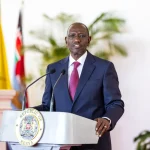

The political temperature in Kenya has hit an unprecedented peak following a series of explosive declarations made by Interior Cabinet Secretary Kipchumba Murkomen against Democracy for Citizens Party (DCP) leader and former Deputy President Rigathi Gachagua.
What began as standard political sparring has devolved into a high-stakes national security showdown. Speaking during a security assessment tour in Tiaty, Baringo County, CS Murkomen leveled severe allegations against Gachagua, accusing him of attempting to build a parallel private militia under the pretext of “protecting votes” ahead of the 2027 General Election.
Murkomen further escalated the narrative by directly accusing Gachagua of historical state sabotage, including orchestrating anti-government violence in 2023 and managing the infamous invasion of former President Uhuru Kenyatta’s Northlands Farm.
1. The Trigger: What Happened in the Ol Kalou By-Election?
To understand why the state is currently leveling militia-building accusations against Gachagua, one must look closely at the aftermath of the recent Ol Kalou parliamentary by-election.
Following intense political battles during the by-election, Gachagua issued public statements warning that “voting alone is no longer enough”. He urged young people across Mount Kenya to organize themselves, stay at polling centers, and actively protect their ballots until the final results are tallied, even if it meant confronting state officers or police forces perceived to be interfering.
However, the Ministry of Interior interpreted Gachagua’s call for vote defense as a veiled attempt to create illegal vigilantism.
“I saw him giving excuses about Ol Kalou, saying young people will protect their vote and beat police officers. That is not an empty statement… What he’s trying to do is recruit a militia before the 2027 elections so that we will have a parallel system.” — CS Kipchumba Murkomen
[ Ol Kalou By-Election Clashes ]
│
┌──────────────┴──────────────┐
▼ ▼
Gachagua Narrative: Government Narrative:
“Youth must stay at polls “Attempting to recruit illegal
to guard ballots against militias disguised as vote
electoral manipulation.” protection units for 2027.”
2. Unearthing Past Ghosts: The Northlands Farm & 2023 Protests Allegations
Perhaps the most startling component of Murkomen’s address was the explicit linking of Gachagua to historical acts of political violence that shook Kenya in recent years.
For the first time, a sitting Interior Cabinet Secretary publicly alleged that Gachagua—while serving as Deputy President—personally organized hired goons to carry out political destruction:
The 2023 Anti-Government Protests: Murkomen claimed Gachagua mobilized street gangs to violently counter opposition protesters during nationwide demonstrations.
The Northlands Farm Raid: Murkomen alleged that individuals under Gachagua’s direct command breached the private property of the Kenyatta family at Northlands Farm, where livestock was stolen, trees were felled, and property destroyed.
By dragging past property invasions and organized violence into the current debate, the state is seeking to establish a pattern of behavior to justify potential legal or law enforcement action against the DCP leader.
3. “Dog Whistles” and the Danger of Ethnic Profiling
Beyond physical violence, the ideological war between Murkomen and Gachagua has centered on language and political terminology.
The Ministry of Interior raised alarms over Gachagua’s repeated use of terms like “Wasaliti” (traitors) to describe Mount Kenya politicians aligned with the ruling government. Murkomen publicly warned that labeling leaders as community traitors acts as a dangerous “dog whistle” that historically precedes targeted violence and civil strife.
Key Rhetorical Battlelines:
The “Wasaliti” Tag: CS Murkomen argued that calling pro-government leaders traitors draws parallels to historical ethnic conflicts where targeted groups were ostracized before facing physical attacks.
The Mau Mau Framing: Gachagua, on the other hand, frequently invokes his lineage as a descendant of Mau Mau freedom fighters, framing his movement as a righteous struggle for the liberation and economic dignity of Mount Kenya against state oppression.
The “Son of a Peasant” vs. “Sunday School Teacher”: While Gachagua highlights his grassroots struggle—famously noting that Kenyan jails were made for human beings and do not intimidate him—Murkomen countered by presenting himself as a law-abiding leader: “I was brought up differently. I am a Sunday school teacher. I am not like you.”
4. The 2027 Calculus: Why Mount Kenya Remains the Ultimate Prize
At the core of this escalating warfare is the strategic battle for the Mount Kenya electorate ahead of 2027.
With millions of registered voters, Mount Kenya historically determines the outcome of presidential elections in Kenya. Following his departure from government, Gachagua has sought to consolidate the region into an impenetrable political monolith under his DCP banner, presenting himself as the sole custodian of the mountain’s political interests.
Concurrently, the state and pro-government loyalists are working aggressively to prevent a single leader from locking down the region. By framing Gachagua’s tactics as lawless, economic sabotage, and militia-oriented, the administration aims to reassure business leaders, farmers, and urban residents that law and order will take precedence over political brinkmanship.
Conclusion
The confrontation between Kipchumba Murkomen and Rigathi Gachagua is no longer a mere battle of words; it has become a fundamental test of state authority versus grassroots opposition defiance. As accusations of militia recruitment, historical farm invasions, and election-related violence dominate the headlines, Kenya enters a crucial political chapter.
Whether these high-level warnings lead to formal legal proceedings or remain part of the high-octane political theater leading to 2027, the line between election campaigning and national security has never been thinner.