

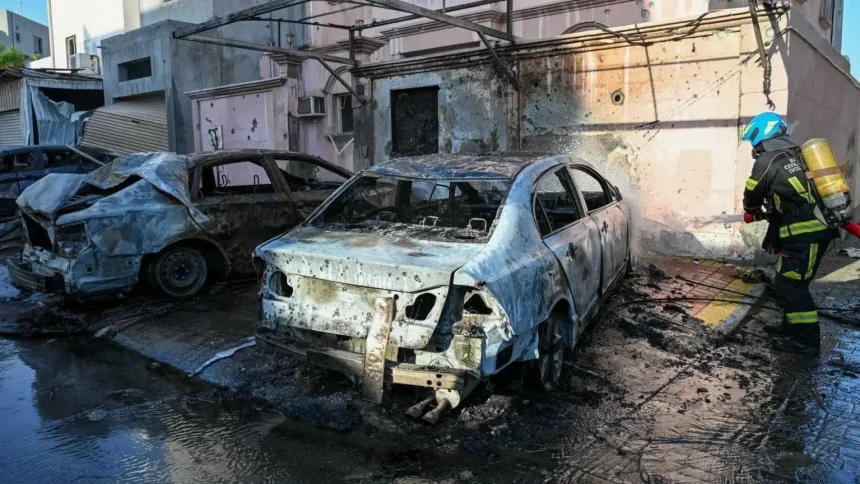
The illusion of peace in the Middle East has completely shattered. What began as a delicate, two-month-old ceasefire has rapidly devolved into a chaotic regional firefight. For the second consecutive day, the United States and Iran have exchanged heavy kinetic strikes, effectively pushing the region to the edge of full-scale war.
Capital FM
This latest wave of violence stems from an aggressive diplomatic standoff. Hours before American warplanes returned to Iranian skies, U.S. President Donald Trump made his position clear to reporters at the White House, accusing Tehran of “playing us for suckers” by intentionally dragging out permanent peace negotiations.
The Guardian
Washington’s new strategy—described by Defense Secretary Pete Hegseth as a readiness to “negotiate with bombs” if needed—has been met with immediate, explosive retaliation from Iran’s Islamic Revolutionary Guard Corps (IRGC), spreading the conflict far beyond Iran’s borders.
From Shaky Ceasefire to Cross-Border Chaos
The current crisis escalated rapidly following the downing of an American Apache helicopter over the Strait of Hormuz. While a Qatari mediating delegation was actively landing in Tehran to bridge diplomatic gaps, the military realities on the ground completely overtook the peace talks.
The Guardian
+ 1
By Thursday morning, June 11, 2026, U.S. Central Command (CENTCOM) confirmed it had “completed” a second, much wider wave of intense airstrikes. Using Navy, Marine Corps, and Air Force assets, the U.S. fired precision-guided munitions—including Tomahawk missiles tracking as close as 40 miles from Tehran—targeting:
The Guardian
+ 1
Military surveillance capabilities
The Jerusalem Post
Ground control stations
The Jerusalem Post
Regional communication networks
The Guardian
Key air defense infrastructure in Bandar Abbas, Qeshm Island, and Sirik
The Guardian
THE REGIONAL RIPPLE EFFECT (JUNE 11, 2026)
[CENTCOM Precision Strikes] ──► Deep into Iranian Air Defenses & Ports
│
┌───────────────────────────────────┴──────────────────────────────────┐
▼ ▼ ▼
[KUWAIT] [BAHRAIN] [JORDAN]
Airspace closed immediately; Emergency air raid sirens IRGC claims ballistic
Kuwait International Airport activated near the U.S. missiles struck the U.S.
diverted multiple flights. Fifth Fleet headquarters. Muwaffaq Salti Airbase.
The Retaliation: Fire Rains Down on U.S. Allies
Unlike previous, localized proxy skirmishes, Iran responded to the second day of American bombardment by launching direct, multi-directional missile and suicide drone assaults against nations hosting U.S. military installations.
1. Kuwait’s Airspace Shutdown
Early Thursday morning, Kuwait’s Directorate General of Civil Aviation took the drastic step of completely closing its national airspace. Inbound commercial flights to Kuwait International Airport were abruptly diverted to alternative regional hubs as local air defenses actively engaged incoming threats.
The Guardian
+ 1
2. Air Raid Sirens in Bahrain
In Bahrain, the Ministry of Interior activated emergency air raid sirens across civilian and military sectors. The alert followed reports of incoming Iranian drone swarms targeting naval bottlenecks and strategic defensive radar facilities closely linked to the U.S. Fifth Fleet.
CBS News
+ 1
3. Ballistic Missile Intercepts over Jordan
The escalation reached deep into the Levant when the IRGC claimed it fired a volley of 12 ballistic missiles targeting a critical American command center at the Muwaffaq Salti Airbase in Jordan. While regional defense networks intercepted a majority of the incoming threats, the U.S. Embassy in Amman issued urgent security warnings advising all American citizens to maintain a low profile.
Capital FM
The Strategic Obstacle: The Lebanon-Hezbollah Connection
The core reason these multi-billion-dollar peace talks keep collapsing comes down to a fundamental disagreement over geopolitical boundaries.
The U.S. and Israel want to isolate the conflict by forcing Iran into a standalone treaty that strips Tehran of its regional influence. Conversely, Iranian Foreign Ministry Spokesperson Esmail Baghaei has maintained that a permanent peace is impossible unless the regional package includes security guarantees for the Lebanese front, protecting Hezbollah from ongoing Israeli ground operations in southern Lebanon.
The Guardian
The Diplomatic Crossroads The Western Strategy The Iranian Strategy
Tactical Leverage Implement a tight naval blockade and “take out millions of barrels of oil every night” to drain Iran’s cash reserves. Use the immediate shutdown of the Strait of Hormuz to spike global fuel prices and force concessions.
Negotiation Scope Demand a clean treaty that halts Iran’s nuclear expansion and stops proxy funding. Insist on a unified regional agreement that permanently protects its “Axis of Resistance.”
Economic Warfare: Tankers in the Crossfire
The physical exchange of missiles has quickly expanded into a high-stakes economic war. President Trump revealed for the first time that the U.S. military has been aggressively intercepting and rerouting Iranian oil routes, stating, “We’ve been taking out millions of barrels of oil every single night.” Washington claims this aggressive action is keeping global oil prices stabilized between $85 and $90 a barrel, preventing a massive spike to $250.
The Guardian
However, enforcing this naval blockade has made commercial shipping incredibly dangerous. Maritime security firms, including Ambrey, reported that a commercial tanker navigating regional waters was struck by a suspected missile during the chaos, leaving two crew members missing and another severely injured.
The Guardian
+ 1
With Iran threatening an absolute shutdown of all maritime traffic through the Strait of Hormuz, global supply chains are facing their most volatile bottleneck since the war originally ignited earlier this year.
CBS News