

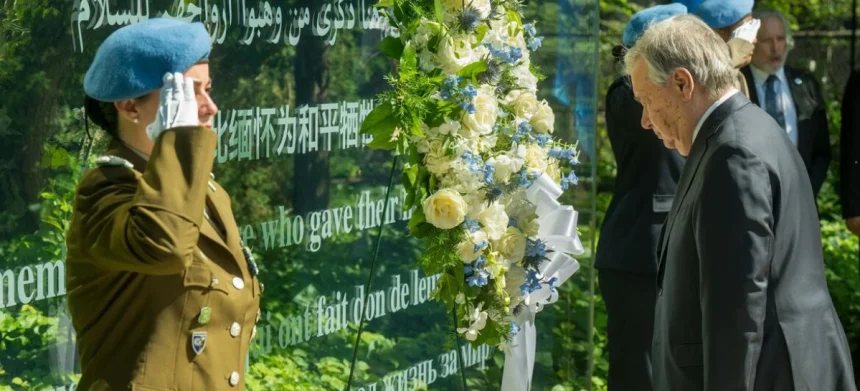
While Kenya has proudly contributed uniformed personnel to UN operations since the 1980s, the terrain has drastically changed. Today, the blue helmets of UN peacekeeping missions in Africa face asymmetric, complex threats that blur the lines between traditional peacekeeping and active combat.
UN peacekeepers navigating high-risk operational environments in Central and East Africa.. Source: Kuni Takahashi / Getty Images
The Deadly Realities of Modern African Deployments
The environments where our fallen heroes served represent two of the most volatile and prolonged security crises on the continent. Peacekeeping here is no longer just about monitoring a static ceasefire line; it involves active protection of civilians under immediate threat from highly mobile armed groups.
1. MINUSCA (Central African Republic)
Major Paul Ndungu Njoroge served under the United Nations Multidimensional Integrated Stabilization Mission in the Central African Republic (MINUSCA).
The Environment: CAR is plagued by deeply fragmented rebel coalitions, including the Seleka and anti-Balaka factions, alongside foreign mercenary groups.
The Threat: Peacekeepers are frequently targeted by ambushes along poorly developed supply routes. The vast, densely forested terrain makes logistics a tactical nightmare, leaving supply convoys vulnerable to improvised explosive devices (IEDs) and hit-and-run tactics.
2. MONUSCO (Democratic Republic of the Congo)
Ms. Alice Wanjiru Chege contributed in a vital civilian capacity within the United Nations Organization Stabilization Mission in the Democratic Republic of the Congo (MONUSCO).
The Environment: Eastern DRC remains an active war zone, with over 120 armed groups—most notably the M23 rebel movement and the Allied Democratic Forces (ADF)—fighting for territorial and resource control.
The Threat: Civilian personnel face immense peril from urban insurgencies, sudden mortar attacks on base perimeters, and targeted kidnappings. Furthermore, MONUSCO has increasingly had to contend with widespread misinformation campaigns that spark violent local protests against UN installations.
Strategic Shift: The New Threat Landscape
According to UN Department of Peace Operations data, the nature of risks facing Kenyan forces and civilian experts has shifted from conventional military standoffs to modern hybrid warfare.
Threat Factor Historical Peacekeeping Modern Peacekeeping (MINUSCA/MONUSCO)
Primary Adversary State military forces bound by treaties Non-state armed actors, rebel factions, and localized militias
Tactical Weapons Standard artillery and small arms IEDs, landmines, and ambushes along unpaved routes
Information Warfare Traditional propaganda leaflets Hyper-targeted digital disinformation on social media
Operational Mandate Observing stable ceasefires Active force projection to protect vulnerable populations
The Digital Battlefield: As noted by UN Secretary-General António Guterres, modern blue helmets are increasingly targeted not just with physical weapons, but with digital tools used to spread harmful information and trigger coordinated attacks on field bases.
The Cost of Global Stability
With 73 Kenyan patriots having paid the ultimate price under the UN flag since the 1980s, Kenya’s 27th-place ranking among global troop contributors underscores a deep institutional commitment.
As the UN pushes for its “Invest in Peace” initiative, the deaths of Major Njoroge and Ms. Chege remind the international community that peacekeeping requires advanced tactical training, robust intelligence networks, and modern equipment to withstand the highly fluid threat matrix of 21st-century conflict zones.