
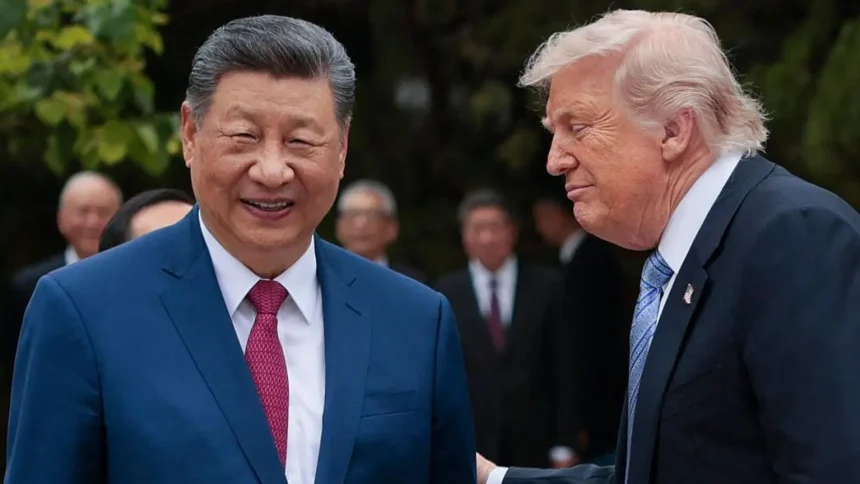
When the leaders of the world’s two largest economies sit down in a room, the conversation is never just about them. The ripples of the May 2026 Trump-Xi Summit are already washing up on distant shores—from the cobalt mines of the Congo to the semiconductor hubs of Southeast Asia.
While the “Strategic Stability” framework established by President Trump and President Xi was short on specific deals, its symbolic weight is massive. For the last five years, the world has lived in fear of an outright “Economic Divorce” between the East and the West. The outcome of the Beijing summit suggests a different path: Managed Interdependence.
Here is how this new era will redefine the global landscape.
1. The “Middle Powers” Breathe a Sigh of Relief
For countries caught in the middle—nations in the European Union, the ASEAN bloc, and across Africa—the “Strategic Stability” framework provides a much-needed breathing room. Throughout 2025, many of these nations were being forced to “pick a side” in everything from 6G infrastructure to digital currency standards.
The summit’s shift toward “Moderate Competition” suggests that the U.S. and China may be moving away from a “zero-sum” mentality. This allows emerging markets to continue doing business with both giants without the immediate fear of retaliatory sanctions. In regions like East Africa, where Chinese infrastructure meets American digital services, this “thaw” could lead to a surge in foreign direct investment (FDI) as the risk of geopolitical whiplash decreases.
2. The Evolution of the “Splinternet”
One of the quietest but most profound discussions in Beijing involved the future of the digital world. For years, we have seen the rise of a “Splinternet”—one led by the U.S. and another by China.
The presence of U.S. tech CEOs at the summit indicates a push to find “interoperability.” While the two nations will likely never share a single digital ecosystem, they are now looking for common ground in AI Safety Standards and Cross-Border Data Flows. If the U.S. and China can agree on even a basic set of “rules of the road” for Artificial Intelligence, it would prevent a catastrophic fragmentation of the global tech economy, ensuring that the 2026 digital landscape remains connected, even if it is competitive.
3. Commodities and the “Green Transition”
The summit’s focus on energy security—specifically the agreement to keep the Strait of Hormuz open—has immediate implications for global commodity markets. By signaling that they will cooperate on energy stability, Trump and Xi have effectively lowered the “geopolitical risk premium” on oil and gas.
Furthermore, the discussion on Rare Earth Metals remains a critical piece of the puzzle. China controls a vast majority of the processing for minerals essential to electric vehicles and renewable energy. If the “Strategic Stability” framework leads to more predictable export policies from Beijing, the global “Green Transition” can accelerate without the constant threat of supply chain weaponization.
4. BRICS+ and the G7: A New Balancing Act
The 2026 summit took place against the backdrop of an expanding BRICS+ bloc, which has sought to create an alternative to Western-led financial systems. However, the cordiality between Trump and Xi suggests that the “Alternative World Order” may not be as confrontational as once thought.
By engaging directly with Trump, Xi is signaling that China still sees the U.S.-led financial system as a vital partner. This could lead to a “hybrid” global financial system where the US Dollar and the Chinese Yuan coexist in a state of uneasy but functional balance, rather than one trying to destroy the other.
5. The “Kyiv Factor” and Global Security
We cannot ignore the shadow of the ongoing conflict in Ukraine. While not officially part of the trade talks, the 700-drone strike on Kyiv that dominated the news cycle during the summit acted as a grim reminder of what happens when diplomacy fails.
The fact that Trump and Xi could speak about “strategic stability” while a major war continues in Europe suggests a pragmatic—some would say cynical—separation of issues. The global community is watching to see if this “Strategic Stability” in the Pacific can eventually translate into a mediated peace in Eastern Europe. If the U.S. and China are truly “aligned” on global stability, their combined pressure could be the only force capable of bringing the warring parties to the table in late 2026.
Conclusion: A World of “Guarded Optimism”
The May 2026 summit did not solve the world’s problems, but it did change the temperature. We are moving away from an era of “Unchecked Escalation” and into an era of “Guarded Realism.”
For the global citizen, this means the threat of a Third World War has arguably receded, but the economic competition will remain fierce. The “Strategic Stability” framework is not a peace treaty; it is a set of guardrails. As long as those guardrails hold, the global economy has a chance to recover, innovate, and grow.
As we look toward the second half of 2026, the world is holding its breath. The handshake in Beijing was the start. Now, the world waits to see the follow-through.