
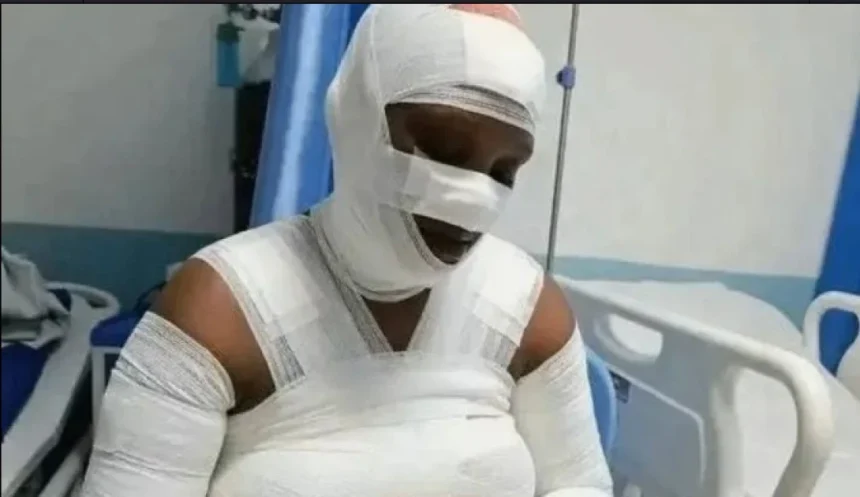
As gospel artiste Rachel Wandeto continues her painful battle for recovery in the specialized burn unit at Kenyatta National Hospital (KNH), the conversation surrounding her horrific assault must shift from basic police blotter reporting to an honest, uncomfortable societal introspection.
The details of what transpired along Obama Road’s 11th Street in Mwiki are undisputed: a young woman was cornered by three masked men, extorted under the false pretense that she had “eaten government money,” doused in premium petrol, and set ablaze.
The catalyst for this barbarism? A viral tattoo of President William Ruto’s face on her chest and her vocal, public support for the current political administration.
While the National Police Service (NPS) and the Directorate of Criminal Investigations (DCI) hunt down the physical perpetrators, the rest of the nation is left to grapple with a terrifying reality. The brutalization of Rachel Wandeto is not an isolated incident of urban crime. It is a symptom of a deeply toxic, highly polarized political ecosystem where the boundary between digital disagreement and offline violence has completely dissolved.
1. When Digital Vitriol Becomes Physical Fire
Long before the match was struck in Mwiki, the groundwork for the attack on Rachel Wandeto was laid out across Kenyan social media feeds. When she first flaunted her political tattoos online earlier this year, she became an instant lightning rod for digital hostility.
In the modern political landscape, algorithms are designed to reward outrage. Public figures, influencers, and ordinary citizens who express strong, non-conforming political alignments are routinely subjected to systematic character assassination, doxxing, and violent threats under the guise of “online political banter.”
The Escalation Matrix of Modern Political Violence
┌───────────────────────────────────────┬───────────────────────────────────────┐
│ Phase 1: Digital Dehumanization │ Phase 2: Offline Execution │
├───────────────────────────────────────┼───────────────────────────────────────┤
│ • Hyper-partisan cyberbullying. │ • Localized surveillance and stalking.│
│ • Creating false economic narratives │ • Physical confrontation fueled by │
│ (e.g., alleging secret state bags). │ unvouched political grievances. │
│ • Devaluating the target’s basic │ • Use of violent force (arson, acid) │
│ humanity over political expression. │ to send a wider collective message. │
└───────────────────────────────────────┴───────────────────────────────────────┘
For Wandeto, the online narrative that she was “profiting from the state” morphed into an entitlement mindset among localized criminal elements. Her attackers did not just see a musician with a political opinion; they saw an unsanctioned recipient of state resources who refused to share the spoils. This transition from internet trolling to physical arson demonstrates exactly how dangerous unchecked cyberbullying can become when left unmonitored by cybersecurity and intelligence cells.
2. The Particular Vulnerability of Women in Polarized Spaces
It is impossible to analyze the Mwiki attack without looking at it through a gendered lens. Throughout Kenya’s political history, women who step into the public arena to express ideological convictions—whether as politicians, activists, or creative artists—face a uniquely vicious brand of violence.
When a man expresses an unpopular political stance, his arguments are usually countered with political rhetoric. When a woman does the same, the retaliation almost always targets her bodily autonomy, her marital status, and her physical safety.
Wandeto’s journey to that hospital bed was marked by gendered displacements: she was allegedly chased away by her husband because of her tattoos, socially isolated by peers, and ultimately physically disfigured by a gang of men.
Using petrol as a weapon of terror is intentionally designed to permanently strip a woman of her physical appearance and her voice. If the creative community and human rights organizations remain silent during this moment, it sends a chilling warning to every young woman in Kenya that choosing to participate in public or political expression carries a life-threatening premium.
3. The Threat of Localized Political Goonism
The intervention of top government officials—including Interior CS Kipchumba Murkomen and Inspector General of Police Douglas Kanja—underlines how seriously the state is taking this breach of national security. The government recognizes that if localized, informal hit squads are allowed to dictate who can support which political faction within specific neighborhoods, the country risks sliding into a state of structural lawlessness.
Key Areas Targeted for Institutional Reforms:
• Enforcing strict localized policing via Nyumba Kumi to expose political extortion gangs.
• Partnering with local boba-boda and community associations to filter out radicalized elements.
• Establishing robust state-backed protection frameworks for artists and cultural influencers.
No citizen should ever have to map out which estate in Nairobi is “safe” for them based on their political leanings. A democracy thrives on the free market of ideas. When neighborhoods become balkanized into hostile political territories where a single tattoo or campaign T-shirt can get you set on fire, the democratic fabric of the republic is in immediate jeopardy.
Conclusion: A Collective Responsibility to Heal
As Rachel Wandeto endures skin graft surgeries and intensive respiratory care at Kenyatta National Hospital, her plight should serve as an urgent wake-up call for the entire nation. Punishing the three masked men who struck the match is a legal necessity, but it will not heal the underlying societal fractures that created them.
Political leaders across the ideological spectrum have a profound, moral obligation to de-escalate their public rhetoric. When politicians continuously use language that paints their opponents not as competitors but as mortal enemies, their words filter down to impressionable, desperate youth in informal settlements as permission to commit acts of terror.
Kenya must return to a political culture where differences are settled on ballot papers, talk shows, and debate podiums—never with petrol and matches. Rachel’s scarred body stands as a tragic monument to what happens when political polarization is allowed to run completely wild. For her sake, and for the future of the nation’s democracy, this must be the absolute turning point.