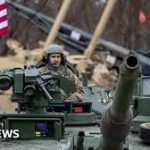

The “Special Relationship” between Washington and Berlin just hit a wall. On Friday evening, May 1, 2026, the Pentagon officially pulled the trigger on a move that has sent shockwaves through the alliance: the United States is withdrawing 5,000 active-duty troops from Germany—roughly 14% of its total presence in the country.
This isn’t a routine rotation or a strategic shift. It’s a “breakup text” delivered via military logistics, sparked by a war of words that turned into a war of positioning.
The Spark: The “Humiliation” Comment
The fuse was lit earlier this week when German Chancellor Friedrich Merz broke the golden rule of trans-Atlantic diplomacy: don’t call the U.S. President “weak” during a hot war.
Speaking to students in Marsberg, Merz criticized the Biden-turned-Trump conflict with Iran, claiming the Iranian leadership was “humiliating” the United States. He mocked the American “lack of strategy,” noting that U.S. officials were traveling to Islamabad for talks only to leave without any results.
President Trump’s response on Truth Social was immediate: “The Chancellor of Germany should spend more time fixing his broken country and less time interfering with those getting rid of the Iran nuclear threat!”
By Friday, the insults turned into orders. Defense Secretary Pete Hegseth confirmed the 5,000-troop drawdown, a move the German Defense Ministry admitted was “foreseeable” given the tension.
What Exactly is Being Cut?
The withdrawal isn’t just about “boots on the ground”; it’s about the type of power being removed. According to Pentagon Spokesman Sean Parnell, the 6-to-12-month withdrawal plan includes:
-
One Full Brigade Combat Team: A major ground-fighting force will be deactivated or moved.
-
The “Long-Range Fires” Battalion: Plans to deploy advanced missile units to Germany later this year have been scrapped.
-
Indo-Pacific Pivot: The Pentagon officially claims these troops are needed for “theater requirements” elsewhere, but the timing leaves no room for doubt—this is a punitive measure.
What stays? For now, the Landstuhl Regional Medical Center—the critical hub for treating American soldiers injured in the Iran conflict—remains untouched. Even Trump knows that cutting medical support during an active war is a bridge too far.
The “Paper Tiger” Ultimatum
This move signals the official end of the “blank check” era for NATO. Trump has recently referred to the alliance as a “paper tiger,” frustrated that European allies like Spain and Germany want U.S. protection but refuse to grant airspace or base access for offensive strikes against Tehran.
The message to Berlin is clear: If you won’t back our play in the Middle East, we won’t back your defense in Europe.
The Double Whammy: Auto Tariffs
As if the troop withdrawal wasn’t enough, Trump doubled down late Friday by tearing up portions of the EU tariff deal. Starting next week, import duties on European cars and trucks will spike from 15% to 25%.
For Germany, a country whose identity is tied to its automotive industry and its security to the U.S. military, this is a “Black Friday” for the history books.
The Verdict: Is the Alliance Dead?
While German officials are trying to play it cool—emphasizing that the trans-Atlantic bond remains “unbreakable”—the reality is a massive fracture. With the war in Iran heating up and the Russia-Ukraine conflict still simmering, a divided NATO is exactly what Washington’s adversaries want to see.
What’s your take? Is Trump right to pull troops from “uncooperative” allies, or is Merz right that the U.S. is being “humiliated” by Iran? Let’s debate in the comments below.