

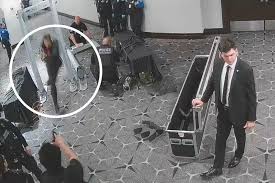
The recently released footage of the security breach at the 2026 White House Correspondents’ Dinner (WHCD) does more than just show a crime in progress; it exposes a terrifying vulnerability in how we protect our highest leaders. When Cole Tomas Allen sprinted through a security checkpoint in a mere four seconds, he wasn’t just running past guards—he was running through a “security bubble” that many assumed was impenetrable.
The “Guest” Loophole: A Trojan Horse Strategy
One of the most alarming revelations from the investigation is that Cole Tomas Allen was not an outsider trying to break in. He was a registered guest at the Washington Hilton.
By checking into the hotel days in advance, Allen effectively bypassed the massive exterior perimeter usually established by the Secret Service for such events. While thousands of journalists and politicians were being screened at the street level, Allen was already inside the building, ten floors above the ballroom.
Security experts call this the “internal threat” scenario. Because he had a room key, Allen could move through guest elevators and back stairwells that are often treated as “low-risk” zones compared to the main gala entrance. His 8:36 p.m. sprint occurred at a secondary magnetometer station—a point where security was transitionary rather than absolute.
The “Friendly Federal Assassin”: Who is Cole Tomas Allen?
To understand the breach, we must look at the man behind it. Cole Tomas Allen, 31, was a Caltech-educated computer scientist with no prior criminal record. His digital footprint paints a picture of a man who viewed himself not as a criminal, but as a “federal fixer.”
In a manifesto titled “Apology and Explanation,” which was sent via a scheduled email to his family just minutes before the attack, Allen referred to himself as a “friendly federal assassin.” He listed administration officials by rank, indicating a cold, mathematical approach to his plan.
His background in tech likely aided his tactical planning. Investigators found that Allen had traveled by train from Torrance, California, to Washington D.C., specifically choosing a route that avoided the more rigorous security screenings found at major airports.
Four Seconds of Chaos
The footage confirms that the breach was a “blitz” attack. Allen did not attempt to hide his weapons—a 12-gauge shotgun and a .38 caliber pistol—as he reached the basement level. Instead, he relied on pure speed.
At 9 miles per hour, he caught the security team in a moment of transition. The video shows agents reacting within two seconds, but in that window, Allen had already cleared the metal detectors. It was only a fortunate stumble near a staircase that allowed Secret Service agents to apprehend him before he could reach the inner doors of the ballroom.
The Future of High-Profile Security
The 2026 incident has sparked immediate calls for reform. President Trump has already proposed the construction of a dedicated “White House Ballroom”—a controlled, government-owned facility that would eliminate the need for third-party hotel venues for high-stakes events.
For the Secret Service, the “four-second failure” is a wake-up call. It suggests that even the most “rigorously tested” security measures can be undone by a motivated individual who understands the architecture of the venue better than the protectors do.