

The stretch of tarmac connecting Kenya’s capital to its coastal gateway has long been described as the country’s economic artery. However, in the early hours of Thursday, March 5, 2026, it once again transformed into a site of national mourning.
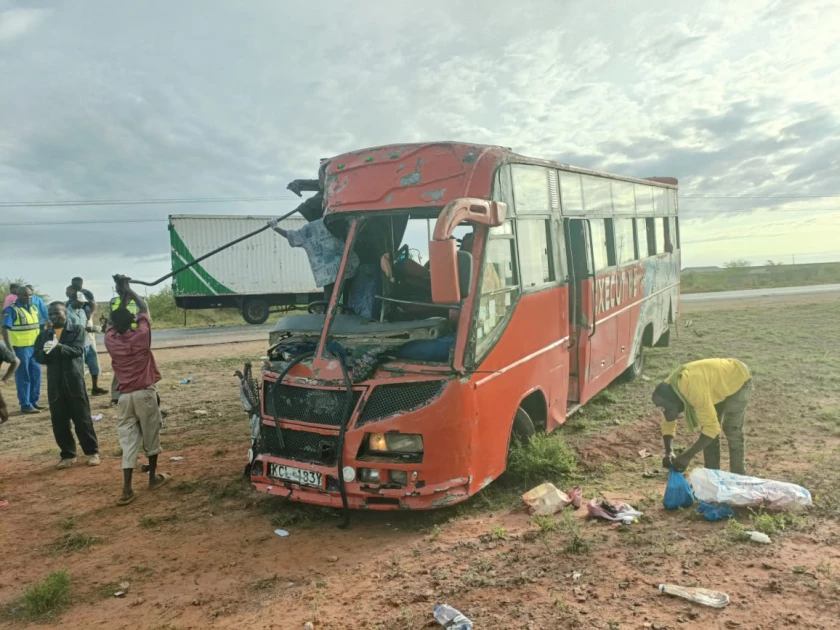
At approximately 5:10 AM, as a heavy mist hung over the Taita-Taveta landscape, a Chania Executive bus and a freight trailer collided in a high-impact head-on crash at the notorious Manyatta area near Maungu. The results were catastrophic: six lives lost on the spot, two drivers in critical condition, and a community left searching for answers.
1. The Anatomy of the Crash
According to Coast Regional Traffic Boss Asha Wario, the Chania Executive bus was navigating its way toward Mombasa when it encountered a trailer, managed by Keitata Company, heading in the opposite direction toward Nairobi.
Preliminary investigations suggest a familiar but deadly catalyst: risky overtaking. Reports indicate that the bus driver attempted to bypass another vehicle, placing the passenger coach directly in the path of the oncoming trailer. The impact was focused on the right side of the bus—the driver’s side—where the force of the collision sheared through the metal, leaving no room for escape for those seated in the front rows.
2. The Rescue Mission at Manyatta
Emergency responders from Voi and Maungu arrived as the sun began to rise, finding a scene of tangled steel and shattered glass.
The Deceased: Six passengers were confirmed dead at the scene. Their bodies were moved to the Moi County Referral Hospital mortuary for identification.
The Survivors: Eight individuals, including both drivers, were pulled from the wreckage with life-threatening injuries. They are currently receiving emergency care at the Moi Referral Hospital in Voi.
3. Why 2026 is Becoming a Deadly Year for Kenyan Roads
This tragedy does not exist in a vacuum. Traffic officials have noted a worrying trend in the first quarter of 2026.
The Data: Over 300 people have died on Kenyan roads in the past 30 days alone.
The Weather Factor: The Kenya Meteorological Department has warned that the current heavy rainfall—expected to last until March 9—is making major highways like the Nairobi-Mombasa road treacherous. The “Manyatta-Maungu” stretch is a known black spot where the road narrows and visibility drops significantly during downpours.
4. A Call for Accountability: KeNHA and NTSA Speak Out
In the wake of the crash, the Kenya National Highways Authority (KeNHA) has reiterated its plea for motorist discipline. The authority highlighted that while infrastructure is being improved, “human error remains the leading cause of 90% of highway fatalities.”
Key Safety Reminders for Motorists:
The 3-Second Rule: Increase following distance during the rainy season.
Avoid Dawn Overtaking: Visibility is at its lowest between 4:00 AM and 6:30 AM.
Speed Governors: NTSA is expected to conduct a fresh crackdown on long-distance bus Saccos to ensure speed limits are strictly adhered to.
5. Community Impact and the “Black Spot” Legacy
Residents of Maungu and Manyatta have long petitioned for better lighting and more prominent signage in this area. For the families of the six victims, these policy discussions come too late. This accident echoes a similar tragedy in December last year near Miasenyi, where seven people lost their lives under almost identical circumstances.
Final Verdict: A National Moment of Reflection
As the wreckage is cleared and traffic begins to flow again toward the coast, the question remains: How many more lives must be lost before the “Manyatta Black Spot” is tamed? For now, the “Pride of Africa” flies its flags at half-mast, both for its struggling airline and for the citizens lost on its most vital road.