
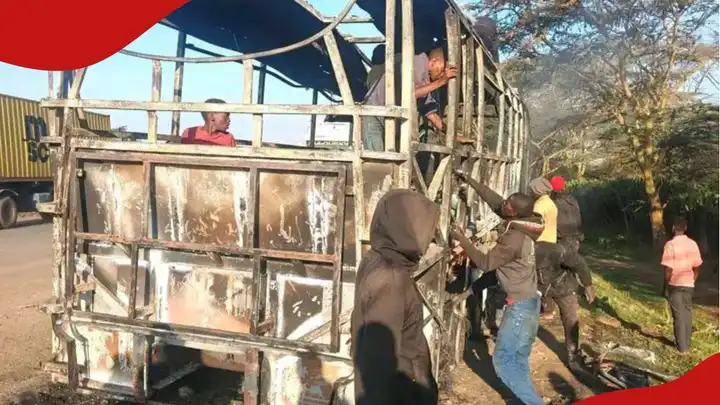
There are places in every nation that become more than geography; they become archives of collective pain. In Kenya, that place is Salgaa. The latest horror—a bus reduced to ashes, lives vanished in flame—is not a singular event. It is the newest layer in a palimpsest of trauma written over decades in blood, oil, and shattered glass. This stretch of the Nakuru-Eldoret highway has transcended its function as a road. It has become a national memorial we drive through, a psychological wound, and a grotesque monument to our inability to protect our own. This blog explores Salgaa not as a black spot, but as a living, breathing entity of Kenyan grief and a mirror to our societal soul.
Section 1: The Geography of Grief: Mapping Memory on Asphalt
Every bend, every faded cross, every scar on the tarmac in Salgaa tells a story.
The Shrines That Line the Road: Drive through Salgaa and you will see them—makeshift crosses, weathered plastic flowers, faded photos nailed to trees. These are not decorations; they are the physical geography of grief, marking where a son, a mother, a family unit ceased to be. The recent fire will spawn a new one, likely larger, more anguished.
The Community of the Bereaved: There exists an unspoken, unwilling fraternity of those who have lost loved ones in Salgaa. They are bound by a shared, horrific memory that isolates them from others. Their trauma is reactivated with every news headline from that same stretch, a collective PTSD triggered by location.
The Drivers’ Dread: For long-distance truck and bus drivers, Salgaa is not just a dangerous spot; it is a valley of the shadow of death they must pass through multiple times a week. The psychological toll—the hyper-vigilance, the superstitions, the nightmares—is a form of occupational hazard never quantified.
Section 2: The Ritual of Recurrence: Crash, Mourn, Forget, Repeat
Salgaa has imposed a grim, predictable ritual upon the nation.
The Catastrophe: A horrific crash, often involving multiple fatalities and graphic imagery.
The National Outrage Cycle: A 72-hour period of front-page headlines, angry tweets, and political promises made at the site. Leaders call it a “tragedy” and vow “immediate action.”
The Committee of Forgetting: The news cycle moves on. The “action” becomes a report filed away. The promises of a dual carriageway are re-announced at the next election cycle. Life continues until…
The Next Catastrophe: The cycle repeats, with a numbing familiarity. This ritual has inured us to horror. We have become experts in performative mourning and professional forgetters.
Section 3: Salgaa as a Diagnostic for the Kenyan Condition
The road is a stark metaphor for the nation’s deeper dysfunctions.
The Illusion of Progress on a Broken Path: We are a country racing towards a modern, middle-income future, but we are doing it on a single-lane, potholed governance system where the rules are optional and the powerful push others off the edge. Salgaa is that contradiction made concrete.
The Sacrificial Lambs of Inefficiency: The victims—often ordinary workers, traders, farmers traveling for opportunity—are the human sacrifice offered on the altar of institutional sloth and corruption. Their deaths are the cost of doing nothing.
A Monument to Short-Termism: Every temporary fix, every unenforced law, every stolen road-safety budget is a brick in the monument that is Salgaa. It is the ultimate testament to a political and bureaucratic culture that cannot think beyond the next news cycle or election.
Section 4: Breaking the Curse: From a Place of Death to a Sanctuary of Life
Exorcising Salgaa’s demons requires more than engineering; it requires a spiritual and civic reckoning.
A Formal Memorial & Museum of Remembrance: Instead of scattered, fading shrines, the nation should build a solemn, official memorial at Salgaa. A place with the names of the thousands lost, a museum educating on road safety, a space for collective mourning that forces leaders to face the cost of their inaction every time they pass.
“Salgaa” as a Verb in Our Lexicon: We must let “Salgaa” evolve from a noun to a verb meaning “to willfully neglect a known danger until it kills.” As in: “They Salgaa-ed the healthcare system.” “They Salgaa-ed the building codes.” Let it be a permanent stain on the legacy of those in power who enable it.
A Citizen’s Oath at the Site: Every newly elected MP, every appointed CS for Transport, every senior police and NTSA official should be required to visit the memorial, read the names of the recent dead, and take a public oath of specific, measurable action. Make the political cost of inaction personal and spiritual.
Conclusion: We Must Stop Feeding the Ghosts
The ghosts of Salgaa are hungry. They are fed by every corrupt inspection, every ignored speed limit, every diverted road fund, and every empty promise. They will continue to demand sacrifices until we break the ritual.