
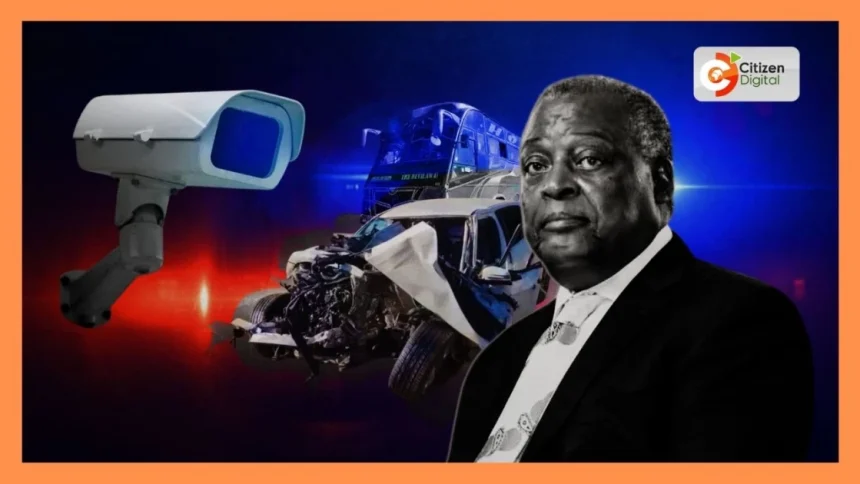
Newly emerged CCTV footage has revealed the final moments of politician Cyrus Jirongo before the catastrophic Naivasha crash that claimed his life, providing a grim and pivotal visual record of the events leading to the tragedy. The video, obtained from a roadside business along the Nairobi-Nakuru highway, shows the politician’s vehicle in its last minutes of travel, offering critical clues that have intensified the investigation into one of Kenya’s most high-profile road accidents this year. This development shifts the incident from speculation to documented timeline, raising urgent questions about road safety on the Nairobi-Nakuru highway and vehicle mechanical integrity.
Section 1: Frame-by-Frame: What the CCTV Footage Shows
The released footage provides a sobering chronological account that investigators are analyzing meticulously.
-
Timestamp & Location: The vehicle, a black [Vehicle Model, e.g., Toyota Land Cruiser], is captured passing a known landmark [e.g., “the Naivasha Total Energies station”] at approximately [Time, e.g., 8:47 PM] on [Date].
-
Vehicle Behavior: Investigators are scrutinizing the vehicle’s speed, lane discipline, and any visible signs of distress—such as erratic swerving, inconsistent braking lights, or smoke—in the minutes before the crash site.
-
Critical Pre-Crash Seconds: The most crucial frames likely show the initial loss of control. Whether it was a tire blowout, sudden mechanical failure, or an attempt to avoid an obstacle, this visual evidence is key to determining the cause of the Naivasha accident.
Section 2: Beyond the Video: The Known Facts of the Crash
The CCTV context aligns with the already established details of the fatal incident.
-
The Crash Scene: The accident occurred near [Specific Location, e.g., “Karai area”] on the deadly Nairobi-Nakuru highway, a stretch notorious for high-speed collisions. The vehicle reportedly veered off the road, rolled multiple times, and collided with [e.g., “roadside barriers/a ditch”].
-
Emergency Response: Cyrus Jirongo was extricated from the wreckage by first responders and rushed to [Hospital Name, e.g., “Naivasha Sub-County Hospital”] where he was pronounced dead on arrival. Other occupants, if any, are reported to be in [condition].
-
Official Statements: The National Police Service confirmed the crash and launched an immediate investigation. Traffic Commandant [Name if available] stated that the CCTV footage forms a “central part of our forensic reconstruction.”
Section 3: The Man in the Headlines: Who Was Cyrus Jirongo?
The tragedy cuts short the life of a controversial yet significant figure in Kenyan politics.
-
Political Career: A former Kabete Member of Parliament and a key figure in the Ford-Kenya and United Democratic Party (UDP) formations. Jirongo was a seasoned politician known for his vocal stance on land issues and his involvement in the “YK’92” movement.
-
Recent Years: He had been active in [Current Political Affiliation/Activities] and was reportedly traveling from/to [Location, e.g., “a political meeting in Nakuru”] at the time of the crash.
-
A Nation’s Reaction: Condolences have poured in from across the political divide, with leaders noting his long-standing, albeit tumultuous, contribution to Kenya’s multi-party democracy.
Section 4: The Broader Crisis: Kenya’s Road Safety Emergency
This tragedy again spotlights a national epidemic.
-
Statistics of Sorrow: The Nairobi-Nakuru highway remains one of Kenya’s most dangerous, with hundreds of fatalities annually due to speeding, overtaking errors, and vehicle conditions.
-
Systemic Failures: Questions arise about the adequacy of highway patrols, the enforcement of speed limits, and the roadworthiness checks for vehicles, especially those used for long-distance travel.
-
A Call for Action: Road safety advocates, including the National Transport and Safety Authority (NTSA), are reiterating calls for mandatory speed governors, stricter PSV regulations, and public awareness campaigns.
Conclusion: From Footage to Future Prevention
The CCTV footage of Cyrus Jirongo’s final journey is more than just evidence for a single case; it is a stark, visual testament to the fragility of life on Kenya’s roads. While it may provide closure on the specific sequence of events, it must also open a renewed national commitment to road safety. Honoring Jirongo’s memory—and that of all road crash victims—requires moving beyond grief to actionable change: better enforcement, safer vehicles, and a collective cultural shift toward responsible driving. The camera has captured the end of one story; it is now our duty to write a safer next chapter.
May His Soul Rest in Peace.