

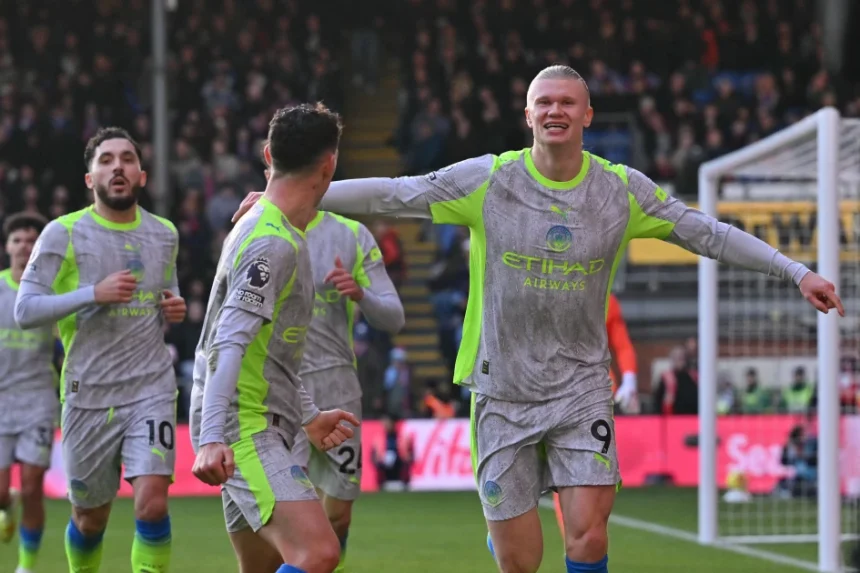
Erling Haaland’s psychological framework—ruthless focus, emotional detachment, relentless repetition—has made him one of football’s most devastating forces. Yet, behind every superpower lies a corresponding vulnerability. For Haaland, his greatest strength—the ability to function like a goal-scoring machine—may come with subtle but significant psychological and relational trade-offs.
This blog asks the uncomfortable question: What does it cost a human being to think like a machine? And can this mindset be sustained without eventual human consequences?
1. The “Efficiency Paradox”: When Optimization Stifles Spontaneity
The Pattern:
Haaland’s game is built on predictable excellence: same runs, same finishes, same celebrations. It’s optimized, but is it inhibiting creative growth?
The Data:
Chance conversion rate: Elite (~28%).
Unexpected creative passes/90 mins: Very low (~0.8).
Dribbles attempted/90 mins: Bottom 25% among forwards.
Psychological Impact:
Cognitive rigidity: Brain trained for specific patterns, potentially reducing adaptive problem-solving in novel situations.
Example: When City faces a deep, organized block (like Atletico Madrid), Haaland can appear frustrated, not inventive.
Quote from a sports psychologist:
“Efficiency is addictive. But the brain that only knows one road forgets how to navigate the forest.”
2. Emotional Repression: The Unseen Toll of “Ice in the Veins”
How It Manifests:
Celebration suppression: Immediate return to focus after goals.
Interview demeanor: Monotone, guarded, rarely revealing.
Conflict avoidance: Rarely seen arguing with refs or opponents.
The Risk:
Emotional bottling: Unprocessed frustration or pressure may manifest physically (tightness, injury) or erupt unexpectedly.
Diminished joy: When winning feels like “expected output,” does the intrinsic reward of playing diminish over time?
Relational disconnect: Teammates may perceive him as distant, transactional.
Historical Precedent:
Cristiano Ronaldo early at Madrid: similar machine-like focus, later showed more expressive, passionate range as he balanced mentality.
Lionel Messi: Allowed himself visible joy, despair, irritation—emotion as fuel, not flaw.
3. The Burden of Legacy: When You’re Built to Break Records
Haaland isn’t just playing matches; he’s chasing history. Every game adds to the weight:
Record Pressure Psychological Load
Goals/season marks Constant comparison to Shearer, Salah, Messi
“Greatest striker ever” talks Legacy anxiety—am I doing enough?
Social media scrutiny Every miss magnified; every goal expected
Agent & brand expectations Commercial demands on mental bandwidth
This legacy consciousness can turn passion into obligation, joy into relief.
4. The Team Dynamics Dilemma: Leader or Lone Wolf?
The Perception:
Teammates respect his output but may find him hard to connect with emotionally.
Leadership style: Leads by example, not inspiration.
Celebration habits: Often breaks away from group celebrations quickly.
Potential Impact on Squad Morale:
In tough moments, teams need emotional rallying, not just clinical finishing.
Case Study: Vincent Kompany’s passionate leadership vs. Haaland’s silent efficiency—both effective, but one builds emotional cohesion, the other builds reliable output.
Guardiola’s Challenge:
Balancing Haaland’s individual mental framework with the need for collective emotional energy.
5. The “Unbreakable” Aura: A Psychological Trap?
Haaland cultivates an image of mental invincibility. But:
What happens after a real slump? (He hasn’t had one yet at City.)
How will he handle a major injury? Routine-dependent minds struggle with forced interruption.
Can he adapt if his physicality declines? The mentality is tied to a specific style of play.
Vulnerability is not a weakness—it’s a learning mechanism. Haaland’s avoidance of it may limit his long-term resilience toolkit.
6. Comparative Case Studies: How Other “Ice Men” Fared
Player Machine-Like Traits Later Challenges
Zlatan Ibrahimović Extreme self-belief, controlled emotions Struggled to adapt to declining mobility; later embraced mentor/entertainer role
Andriy Shevchenko Clinical, focused, quiet Failed to adapt to Premier League; confidence shattered
Ruud van Nistelrooy Pure penalty-box killer Struggled when system didn’t serve him; fell out with teammates
Robert Lewandowski Professional, efficient Evolved to include playmaking, leadership—balanced machine with man
Lesson: The most sustainable careers balance efficiency with evolution.
7. The Off-Pitch Persona: Is There a “Real” Haaland?
Public persona: Guarded, repetitive in interviews.
Private glimpses: Chess player, gamer, nature lover—activities of solitary focus.
Brand partnerships: Chose BMW, Viaplay—efficiency and performance aligned brands.
Question: Has the “Haaland brand” subsumed the person? Where does Erling the human end and Haaland the product begin?
8. Sustainable Success: Recommendations for Balance
For Haaland (through his support system):
Emotional Expression Training: Work with a psychologist to channel, not suppress, emotion.
Creative Expansion: Encourage playful, low-stakes experimentation in training (e.g., futsal, different positions).
Vulnerability Rituals: Occasionally share struggles publicly—builds connection and relieves perfectionism pressure.
Legacy Detachment: Set personal goals unrelated to records (e.g., “improve link-up play,” “enjoy 10 matches”).
For Teams & Coaches:
Assign a “Connection Role”: A teammate tasked with ensuring his integration in group social activities.
Celebration Coaching: Encourage him to stay in group celebrations 10 seconds longer.
Narrative Shift: Media team highlights his human moments, not just robotic efficiency.
9. The Bigger Picture: What Haaland Represents in Modern Sport
Haaland is a prototype of the next-gen athlete: data-optimized, brand-aware, mentally engineered for output. He raises ethical and psychological questions:
Are we creating sporting machines at the cost of well-rounded humans?
Does fandom now value reliability over relatability?
Will future academies produce more Haalands—technically perfect, psychologically streamlined?
Conclusion: The Human Behind the Machine
Erling Haaland’s mentality is a masterpiece of sporting psychology—but masterpieces often exist behind glass, untouchable and fragile. The true test of his greatness won’t be how many records he breaks, but whether he can remain human while performing like a machine.
As one former elite athlete turned psychologist noted:
“We teach athletes to be warriors, but we forget to teach them to be people. The jersey comes off eventually. Who’s left?”
For Haaland’s sake—and for the soul of modern sport—we must hope that beneath the ice, the fire of humanity still burns.
Your Reflection:
Is emotional detachment a fair price for excellence? Should we care if athletes are relatable, as long as they perform?