
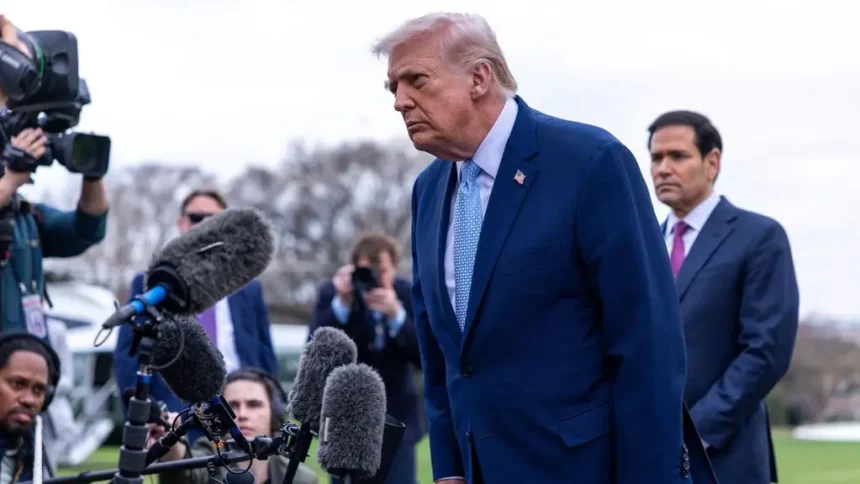
On Monday, March 23, 2026, the world woke up to a rare glimmer of diplomatic hope. Just hours before a 48-hour ultimatum was set to expire—a deadline that carried the threat of “obliterating” Iran’s power grid—President Donald Trump announced a five-day postponement of all military strikes on Iranian energy infrastructure.
The reason? According to the President’s Truth Social posts, the U.S. and Iran have engaged in “very good and productive conversations regarding a complete and total resolution of our hostilities.” For a global economy currently “taken hostage” by the three-week closure of the Strait of Hormuz, this news was the equivalent of an emergency transfusion.
The Market Reacts: Oil Tumbles, Stocks Surge
The impact was instantaneous. As news of the “tenor and tone” of the talks spread, the financial world breathed a sigh of relief:
Oil Prices: Brent Crude, which had been flirting with record highs, plunged over 10%, dropping back toward the $100-a-barrel mark.
Global Equities: Stock futures in New York and London surged, reversing a week of steady declines as investors bet on a potential “off-ramp” for the conflict.
The “Asian Crisis” Ease: For nations like Singapore, where the Foreign Minister recently labeled the Hormuz closure an “Asian crisis,” the postponement offers a critical window to stabilize supply chains.
The Hidden Cost of the “Power Plant” Threat
Why were these specific strikes so controversial? Unlike the precision strikes on underground missile sites (Operation Epic Fury), bombing power plants is widely viewed as a “scorched earth” tactic.
Humanitarian Impact: Targeting electricity in a modern nation knocks out hospitals, food refrigeration, and—most critically in the Gulf—desalination plants.
The Retaliation Cycle: Tehran had already warned that if their lights went out, they would “irreversibly destroy” the water and energy systems of regional U.S. allies, including the UAE and Saudi Arabia.
The “War Crime” Debate: International legal scholars had begun questioning the legality of such strikes, arguing they are “inherently indiscriminate.”
The 120-Hour Clock: What Happens Next?
Trump’s “Five-Day Reprieve” is not a peace treaty; it is a high-pressure diplomatic trial. The talks, which are expected to continue through the week, face massive hurdles:
The Reopening Clause: The U.S. and UK (led by PM Keir Starmer) insist that the Strait of Hormuz must be “fully open, without threat.” Iran, however, claims the waterway is already open but “ships fear passage” due to U.S.-Israeli aggression.
The “Desperation” Factor: U.S. Admiral Brad Cooper recently noted that Iran is operating from a “sign of desperation,” targeting civilian sites as their naval assets dwindle. The U.S. likely believes the current pause is the best time to extract a “Maximum Pressure” deal.
The Netanyahu Variable: While Trump signals de-escalation, Israeli Prime Minister Netanyahu remains in a “retaliate on all fronts” posture following Iranian missile strikes on southern Israel. A single misstep by regional proxies could shatter the five-day window.
Conclusion: The Deal of the Century or a Delay of the Inevitable?
President Trump has once again leaned into his persona as the “Ultimate Negotiator.” By taking the “Power Plant Obliteration” option off the table for 120 hours, he has created a vacuum that can only be filled by a diplomatic breakthrough or a catastrophic escalation.
As the clock ticks toward Friday, March 27, the world is left asking: Is Tehran finally ready for a “complete and total resolution,” or is this merely a tactical pause to re-arm their remaining “spider-hole” defenses?