
When the World Health Organization (WHO) and Africa CDC officially elevated the Bundibugyo Ebola outbreak to a global emergency on May 16, 2026, international headlines focused almost entirely on the science: a rare strain, a lack of approved vaccines, and zero targeted drugs.
Wikipedia
But talk to any frontline responder setting up isolation tents in Bunia or Mongbwalu, and they will tell you that the molecular makeup of the virus is only half the problem. The real battle against Ebola isn’t won or lost in a clean laboratory. It is fought in mud, through active conflict zones, and across highly porous international borders.
The BMJ
In eastern Democratic Republic of the Congo (DRC), the Ebola containment challenges in Ituri represent a perfect storm of logistical, security, and financial obstacles. Here is why stopping the spread of this lethal virus has become an unprecedented operational nightmare.
The Shadow Economy: Gold Mining and the Mirage of Borders
Epidemiologists track viruses using vectors and maps. But in northeastern DRC, the human mapping of the region is entirely dictated by resource economics—specifically, the informal gold-mining sector.
[The Migration Vector]
Mongbwalu Artisanal Mines ──► Unregulated Footpaths ──► Border Markets (Lake Albert) ──► Western Uganda
Mongbwalu, the epicenter of the initial spike in cases, is home to a highly mobile, transient population of thousands of artisanal miners.
The London School of Hygiene & Tropical Medicine
The Mobility Problem: These workers do not operate in fixed corporate environments. They move constantly between informal mining camps, semi-urban trading centers, and their home villages based on where the day’s yield is highest.
The Surveillance Blindspot: When a miner falls ill with the initial, non-specific symptoms of Ebola (fever, fatigue, joint pain), their instinct is often to return to their family or seek care in small, unlicensed private drug shops hidden in the bush.
By the time health workers identify a suspected case, the individual’s contacts have already dispersed along thousands of unregulated footpaths leading toward Lake Albert and directly across into Uganda. This intense mobility is exactly how the virus successfully hitchhiked into Kampala’s dense urban core within weeks of the initial outbreak.
Active Insecurity: Contact Tracing in a War Zone
The golden rule of defeating an epidemic is simple: find every contact, isolate them, and monitor them for 21 days. But how do you execute contact tracing when your tracking teams face the very real threat of armed ambush?
Ituri Province remains one of the most volatile regions in Central Africa, torn by longstanding conflicts between localized ethnic militias and rebel factions.
The Guardian
The Security Bottleneck
The WHO notes that while over 65 critical high-risk contacts were listed early in the Rwampara health zone, active follow-up has completely broken down in specific sectors due to shifting frontlines. Rapid response teams cannot travel safely without heavily armed UN or government escorts—but moving with a military presence instantly alienates the local community, fueling deep-seated distrust and conspiracy theories about the origin of the disease.
The Tragically Common Outcome: Because security constraints delay tracking teams, multiple listed contacts have become highly symptomatic and died directly in their communities before they could be safely transported to an Ebola Treatment Center (ETC).
World Health Organization (WHO)
The Humanitarian Crossfire: Defunding and Supply Bottlenecks
Compounding the security crisis is a severe infrastructure deficit. The current epidemic strikes at a time when the global humanitarian system is profoundly overstretched, resulting in sweeping structural vulnerabilities.
International Rescue Committee
Recent international funding cuts to regional health systems and a reduction in active USAID and CDC field personnel have left local health zones without basic defensive buffers.
International Rescue Committee
[Logistical Requirements vs. Reality]
Supply Needs: [50 Tons of Disinfectants, Tanks, and PPE]
Infrastructure Gap: [Impassable Roads + Conflict Checkpoints]
Result: [Delayed Field Deployment to Remote Hotspots]
While agencies like UNICEF have rapidly mobilized nearly 50 metric tons of emergency infection prevention control (IPC) supplies—including water purification units, sprayers, and personal protective equipment (PPE)—getting these assets from the airport in Bunia to deep rural outposts in Mongbwalu is an agonizingly slow process.
Northeastern DRC features practically no paved highways; rainy season downpours routinely turn vital supply routes into impassable rivers of thick mud, stranding supply trucks for days at a time.
Cross-Border Defenses: A Regional Coordination Race
Because the virus has already skipped borders, containment is now a multinational diplomatic race. The current figures illustrate the high stakes facing regional health authorities as they try to keep a lid on a full-blown trans-national crisis.
World Health Organization (WHO)
Metric DRC Baseline (Ituri/North Kivu) Uganda Status (Kampala Corridor)
Suspected Cases 540+ Under active investigation
Confirmed Cases 30+ 2 (Both admitted to ICU)
Border Management Porous, high informal traffic Enhanced thermal screening at official points
Response Level Level 3 Corporate Emergency (UNICEF) Activated Incident Management (Africa CDC)
In response, Africa CDC has activated its continental Incident Management Support Team (IMST) to unify the response across the DRC, Uganda, and South Sudan.
Africa CDC
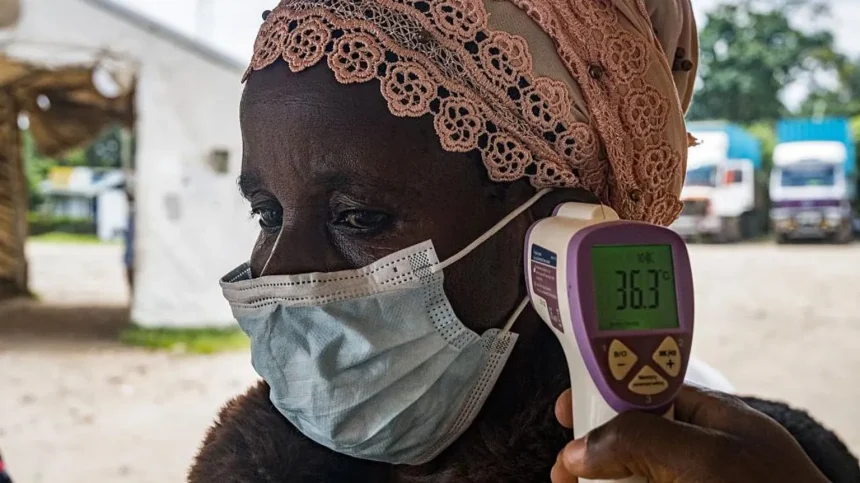
Rather than imposing economically catastrophic trade blockades or travel bans—which the WHO strongly advises against because they drive traffic underground into unmonitored bush paths—the strategy centers on deploying mobile laboratories and thermal screening stations directly to informal entry points along the border.
World Health Organization (WHO)
Outlook: The Reality of the Response
The 17th Ebola outbreak in the DRC is testing the limits of modern epidemiological response. The country possesses some of the most experienced, resilient healthcare workers in the world, individuals who have beaten back successive waves of viral threats over the last decade.
But experience alone cannot build roads, silence guns, or trace contacts through a war zone. If the international community wants to stop the Bundibugyo strain from cementing a permanent footprint in East African cities, it must look beyond laboratory innovation. The response requires immediate, flexible funding, ironclad logistical pipelines, and safe humanitarian access corridors. Until responders can move safely on the ground, the virus will continue to hold the advantage.
International Rescue Committee
To analyze the geopolitical and economic dimensions of this response:
Examine the impact of international funding cuts on African health security
Review Africa CDC’s cross-border health framework