
The crisis in Migori is no longer just a meteorological event; it is a forensic one. As of Monday, March 2, 2026, the “suspended fear” felt by residents has been replaced by a demand for technical accountability.
Technical observations of the main Migori Bridge have identified “worrying signs of distress” specifically at the Suna West expansion joints. To the layperson, these are cracks; to engineers, they are a sign that the bridge is losing its ability to handle thermal expansion and heavy load-bearing pressure simultaneously.
1. The Expansion Joint “Red Flag”
Governor Ochilo Ayacko’s recent advisory was triggered by visible deterioration on the Suna West side. Expansion joints are designed to allow bridge decks to move safely under varying temperatures and traffic loads.
The Failure: Decades of heavy commercial transit—trucks moving goods from the Isebania border to Nairobi—combined with unprecedented hydraulic pressure from the swollen River Migori, have likely “fatigued” these joints beyond repair.
The Danger: A failure in an expansion joint can lead to “deck jumping” or, in worst-case scenarios, a partial collapse of the span into the river below.
2. The Gabion Failure: Why the Footbridge Disappeared
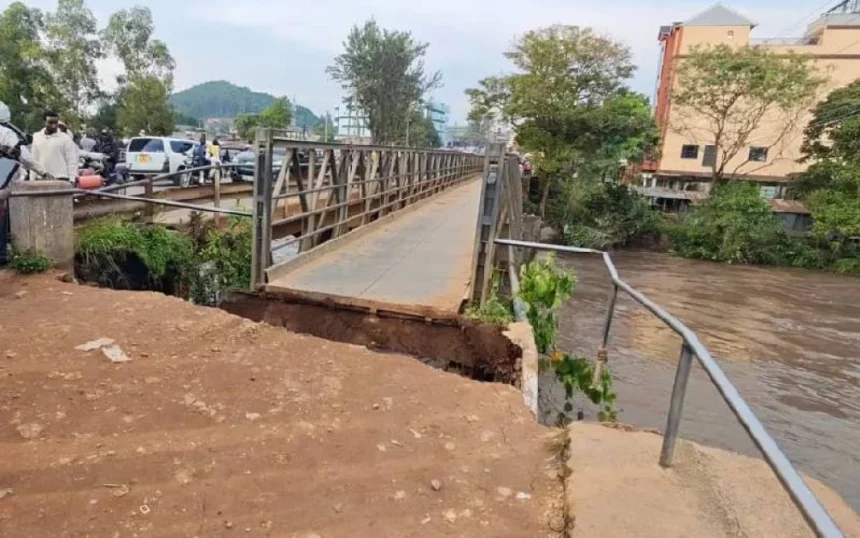
While the main bridge hangs on, the Migori Footbridge has been officially declared “dangerously compromised” by KeNHA.
The Engineering Gap: The bridge relied on gabion protection (stone-filled wire cages) to shield its foundations from erosion.
The Result: The torrential rains of late February simply outpaced the gabions’ capacity. The riverbed was “scoured” away, leaving the footbridge cut off from the bank and literally hanging in mid-air.
3. The “Blame Game”: Who Owns the Crisis?
A significant portion of the public outcry is directed at the perceived lack of coordination between the National Government (KeNHA) and the County Government of Migori.
The County’s Stance: The County Department of Environment and Disaster Management claims they can only provide “interim safety measures” while the heavy lifting remains a national responsibility.
KeNHA’s Stance: KeNHA has closed the footbridge but maintains that the main bridge is a shared “A1” international highway responsibility.
4. The “Climate Lag” in Engineering
The most disturbing realization from the ongoing 2026 audit is that Migori’s infrastructure was built using historical hydrological data that no longer exists.
“The rainfall is simply heavier and faster than our baselines anticipated,” says an engineer working on the site. “We are trying to protect 1980s engineering from 2026 weather.”