
The “Separate Incident” That Led to Tragedy
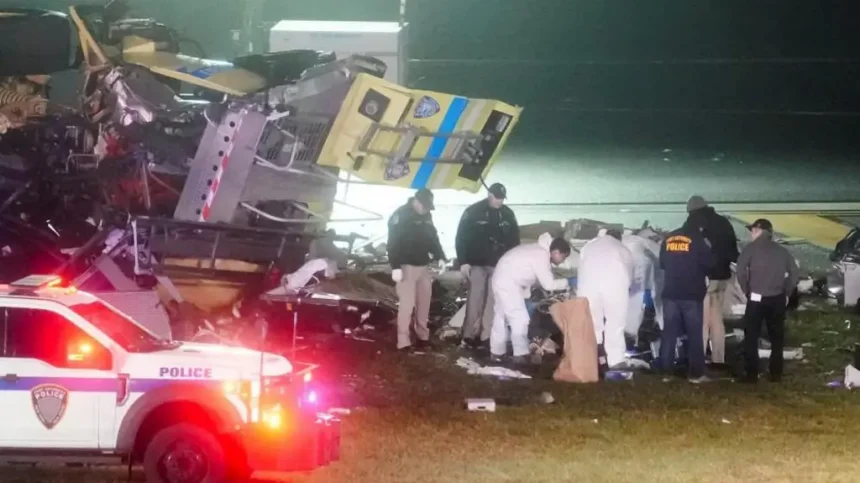
As the investigation into the fatal collision at LaGuardia Airport (LGA) intensifies, a clearer picture is emerging of the chaotic environment on the night of March 22. It is now confirmed that the Port Authority fire truck involved in the crash, designated “Truck 1,” was not on a routine patrol. It was responding to an emergency involving United Airlines Flight 2384, which had aborted its takeoff after an anti-ice warning light and a reported “odor” in the cabin.
While ground crews were scrambling to assist the United jet, Air Canada Express Flight 8646 (operated by Jazz Aviation) was on short final for Runway 4. The intersection of these two events—one an aborted takeoff and the other a routine landing—created a “perfect storm” of miscommunication.
The Jazz Aviation Response: Mourning the Loss of Two Pilots
In a somber statement released early Monday, Jazz Aviation President Doug Clarke expressed the company’s “deepest condolences” to the families of the two pilots. While their names have not yet been released pending next-of-kin notification, both were confirmed to be based out of Canada.
“Today is an incredibly difficult day for our airline and our employees. We are fully committed to cooperating with the relevant authorities to determine what happened.” — Doug Clarke, Jazz Aviation LP.
The aircraft, a 20-year-old Bombardier CRJ-900 (Registration C-GNJZ), had a clean safety record prior to the incident. Photos from the scene show the nose of the jet crushed entirely back to the cockpit windows, a testament to the violent impact even at the relatively low ground speed of 24 mph (39 km/h).
NTSB Focus: Why Was the Truck Cleared?
The National Transportation Safety Board (NTSB) “Go-Team” arrived on-site by 5:00 AM this morning. Their investigation is currently laser-focused on the Ground Control protocols at LaGuardia.
Key Questions for the NTSB:
Visual Obstructions: Heavy rain was reported in NYC on Sunday night. Did “standing water” on the tarmac or poor visibility contribute to the truck driver or pilots not seeing each other?
Audio Hand-off: Was there a conflict between the Ground controller (managing the fire truck) and the Tower controller (managing the landing plane)?
Technology Gaps: Why didn’t the ASDE-X (Airport Surface Detection Equipment) alert the controllers to the runway incursion before the truck entered the path of the landing jet?
The Toll on the Ground and in the Air
While the deaths of the pilots are the primary tragedy, the physical and emotional toll on the survivors is significant.
Hospitalizations: Out of the 76 people on board, 41 were taken to Queens hospitals. As of 2:00 PM today, nine remain hospitalized, some with serious injuries including concussions and fractures.
The First Responders: The two Port Authority officers inside the overturned fire truck are reportedly in stable condition at a local hospital, suffering from broken limbs.
The Witness Perspective: Passengers on nearby flights described a “flash of light and a loud thud,” followed by a fleet of red rescue vehicles swarming the runway in the dark.
Conclusion: Searching for Answers
LaGuardia Airport remains under a ground stop, with a tentative reopening scheduled for late this afternoon. However, for the aviation industry, the “reopening” of the airport is secondary to the “opening” of a deep-seated safety inquiry. In an era of high-tech flight, the fact that a basic communication error could lead to two deaths on a runway in New York City is a wake-up call that cannot be ignored.