

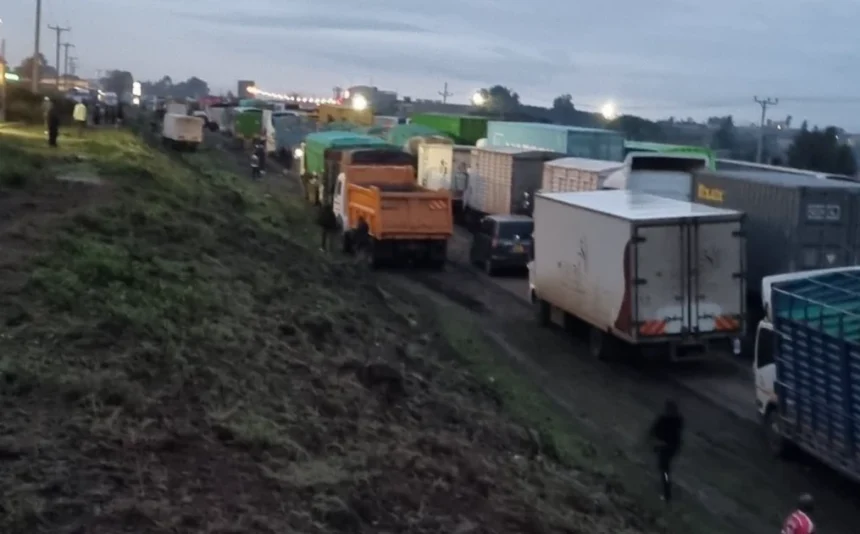
The Nairobi-Nakuru highway is often called the “lifeline” of East Africa, connecting the port of Mombasa to the Great Lakes region. But on the night of Friday, February 27, 2026, that lifeline felt more like a noose.
As hundreds of families shivered in their cars near the Gilgil weighbridge, the conversation on social media shifted from frustration to a fierce political debate. With the 2027 General Election looming, the “Gilgil Trap” has become a potent symbol of infrastructure promises yet to be delivered.
The “Artificial” Congestion Debate
While Gilgil Base Commander Hussein officially blamed “high vehicle volume” and “overlapping,” some observers are pointing to a more systemic failure.
Earlier today, opposition leaders—including Rigathi Gachagua and Kalonzo Musyoka—held a series of high-profile rallies across Mai Mahiu, Naivasha, and Gilgil. Their “one-term” narrative against the current administration was bolstered by the literal backdrop of the gridlock.
“Kenyans are sleeping on the road while the government talks about 2027,” Gachagua told supporters in Mai Mahiu.
Critics of the government argue that the delay in the Rironi-Mau Summit Expressway (the planned dual carriageway) is a failure of both policy and empathy.
The Economic Hemorrhage
Beyond the politics, the numbers are staggering. The 15-hour standstill didn’t just affect travelers; it halted the wheels of commerce.
Logistics: Companies like Ena Coach reported total paralysis of parcel and passenger services.
Agriculture: Perishable goods heading from the Rift Valley to Nairobi sat in non-refrigerated trucks for an extra half-day.
Fuel Waste: Thousands of liters of fuel were burned by idling engines as drivers desperately tried to keep warm.
The “Overlapping” Scapegoat?
KeNHA often cites “lane indiscipline” as the primary cause of these snarl-ups. While it is true that overlapping makes it nearly impossible for tow trucks to reach breakdowns, many motorists argue that the indiscipline is a symptom of a broken system, not the cause. When a two-lane road serves an entire continent’s transit needs, the margin for error is zero.
Is There a Solution in Sight?
As of February 28, 2026, the official KeNHA stance remains focused on “restoring flow” and advising alternative routes through Ol Kalou and Njabini. However, the long-term solution—the expansion of the highway—remains entangled in financing and public-private partnership (PPP) debates.


