

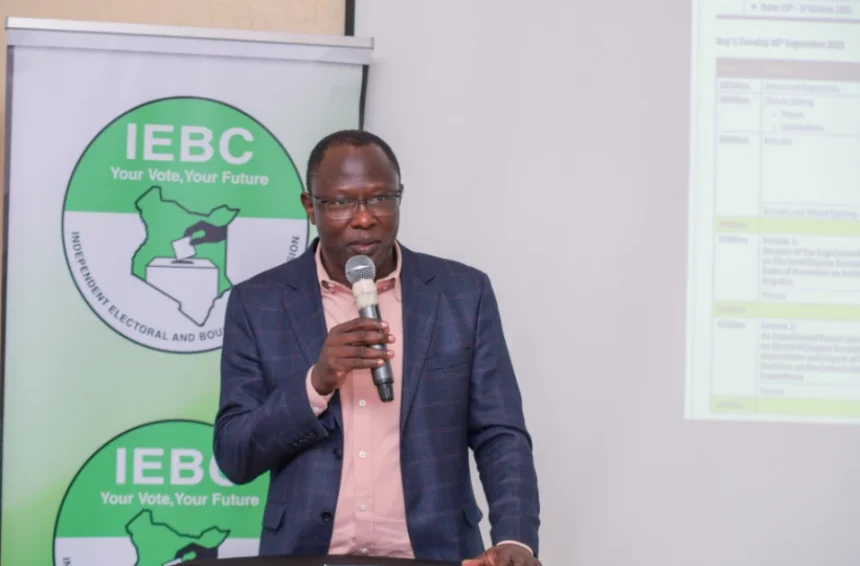
The roadmap to the 2027 General Election just got a lot more active. Following a strategic planning meeting held this week, the Independent Electoral and Boundaries Commission (IEBC) has announced a high-octane Enhanced Continuous Voter Registration (ECVR) exercise set to kick off on Monday, March 30, 2026.
Having already successfully added 277,903 new voters to the national register since the year began, the Commission is now setting its sights on a much loftier goal: registering 2.5 million new citizens in just one month.
1. A Shift in Strategy: The Proactive Model
Chairperson Erastus Ethekon noted that the Commission is ditching the “wait-at-the-office” approach. Instead of expecting Kenyans to visit constituency headquarters, the IEBC is deploying thousands of temporary clerks to bring registration services directly to the people.
“We are shifting from a passive model to a proactive one,” Ethekon stated. “The personnel will travel from village to village, delivering registration services directly to the people at the lowest feasible administrative levels.”
2. Target: The 2.5 Million “Phase One” Blitz
The 30-day exercise specifically targets the large cohort of youth who have turned 18 since the last mass registration cycle.
Phase One Target: 2.5 million new registrations.
Long-term Goal: 6.3 million new voters to reach a grand total of 28.5 million on the roll by 2027.
Focus Areas: Remote, marginalized, and hard-to-reach areas will receive dedicated mobile units.
3. Upgraded Tech and “Real-Time” Data
To ensure the process is seamless, the IEBC has optimized its Biometric Voter Registration (BVR) modules within the KIEMS kits.
Improved Connectivity: The Commission is prioritizing network stability to ensure that transfers and new registrations are captured and uploaded in real-time.
Kit Rotation: Commissioner Dr. Ann Nderitu emphasized a strict kit movement schedule, ensuring that every ward and sub-location is visited within the 30-day window.
4. How and Where to Register
The ECVR exercise is designed for maximum accessibility. Eligible Kenyans should look out for:
Mobile Registration Units: Visiting local villages and markets.
Ward-Level Centers: Temporary stations set up in schools and community halls.
Huduma Centres: Continuing to provide registration services in urban hubs.
Requirements: You must present your original National ID card or a valid Kenyan Passport. Note that while you will receive an acknowledgement slip, it is not a requirement for voting on election day—your biometrics are your primary ID.
The Bottom Line
With just one year and a few months left until the 2027 polls, the IEBC is racing against time to build a “credible and inclusive” register. As the Chairperson concluded, the success of this exercise depends on the integrity of the clerks and the participation of the youth.