

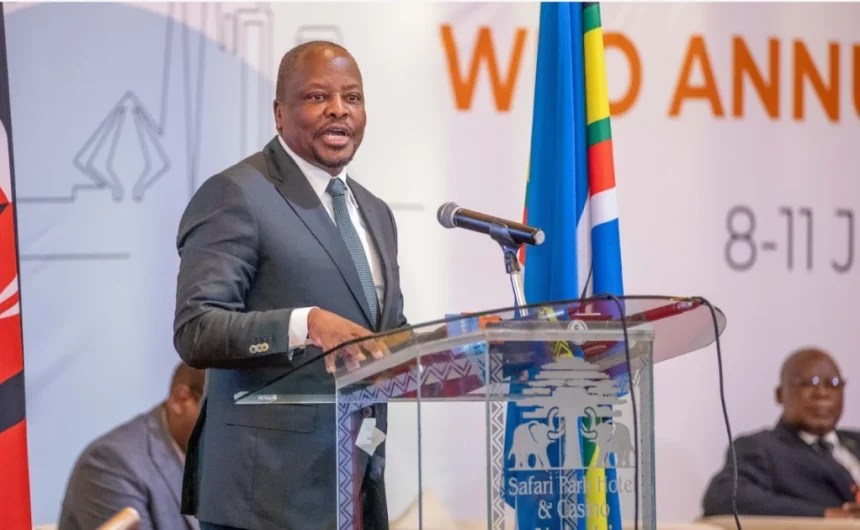
When Agriculture Cabinet Secretary Mutahi Kagwe stood before the World Farmers’ Organisation (WFO) General Assembly in Nairobi and declared that “the life of an African farmer is not worth less than a farmer anywhere else,” he was pointing directly at a deeply entrenched geopolitical hypocrisy.
The Star
The global agricultural trade system has quietly normalized a trade cycle that borders on the absurd. Every year, European-based chemical conglomerates manufacture and export over 120,000 tonnes of Highly Hazardous Pesticides (HHPs) directly to developing nations—predominantly in Africa and Latin America. These are chemical compounds that have been strictly outlawed on European farms for years due to verified links to cancer, reproductive failure, and environmental collapse.
Africa Confidential
+ 1
But the hypocrisy doesn’t stop at the shipping port. Once Kenyan smallholder farmers use these imported chemicals to protect their crops, Western nations dispatch border customs officials to intercept, condemn, and destroy African food imports because they contain traces of those exact same banned chemicals.
Africa Confidential
Anatomy of the Toxic Loop
This trade double standard operates as a multi-stage economic trap for African economies, shifting the health and financial burdens entirely onto developing markets.
[1. Manufacture in EU] ──► Banned for European use due to health/cancer risks.
│
▼
[2. Export to Africa] ──► Sold to Kenyan/African smallholders via local subsidiaries.
│
▼
[3. Harvest & Export] ──► Kenyan farmers grow produce using the legal local inputs.
│
▼
[4. Border Rejection] ◄── EU customs reject the food for containing banned residues.
This cycle has triggered severe trade friction. Last year alone, strict enforcement of Maximum Residue Limits (MRLs) by international customs led to the interception and destruction of over 118,000 tonnes of Kenyan vegetables and fruits (including French beans, peas, and avocados). The smallholder farmer loses their crop, loses their investment, and bears the physical health toll of handling the poison, while the chemical manufacturer profits on both ends.
The Chemical Culprits: Banned in Europe, Pushed in Kenya
According to research from the Route to Food Initiative (RTFI) and international human rights watchdogs, nearly 48% of all pesticides actively used in Kenyan food production are classified as highly hazardous and are illegal in the European Union.
Africa Confidential
A landmark public interest lawsuit filed in Kenya’s Environment and Land Court has specifically targeted multinational manufacturers and local distributors to bar the sale of these toxic molecules on the local market.
Africa Confidential
Major Intercepted Molecules Under Legal Scrutiny
Active Chemical Ingredient Primary Global Manufacturer/Distributor European Union Legal Status Documented Chronic Health / Ecological Risks
Glyphosate Monsanto Kenya / Bayer East Africa Under heavy restriction / phased out Strong links to non-Hodgkin lymphoma and severe soil biome degradation.
Paraquat Syngenta Agrochemicals Banned completely Highly acute toxicity; linked to long-term respiratory failure and Parkinson’s disease.
Chlorpyrifos Twiga Chemical Industries Banned completely Potent neurotoxin known to cause severe developmental deficits in children.
Imidacloprid Bayer East Africa / BASF Banned completely Neonicotinoid directly responsible for the catastrophic collapse of global bee populations.
The Push for a Binding Export Ban
The defensive argument historically used by global agrochemical giants is that these chemicals are necessary to maintain crop yields in tropical climates where pests multiply rapidly. They argue that as long as local regulatory bodies like Kenya’s Pest Control Products Board (PCPB) approve the inputs, the trade is entirely legal.
However, civil society and African leaders are pushing back against this narrative, arguing that regulatory approval in weak enforcement contexts does not equal safety.
“It should go without saying that a chemical considered too toxic for a consumer in Berlin or Paris is equally toxic for a consumer or farmer in Nakuru or Murang’a. The European Union Commission must deliver on its long-delayed promise to pass a comprehensive, legally binding export ban on all forbidden pesticides.”
Human Rights Watch
— Joint Statement by the End Toxic Pesticide Trade Coalition
A Turning Tide in Nairobi
Kenya is no longer waiting passively for Western regulators to do the right thing. Building on the momentum of the Ministry of Agriculture’s recent directive to systematically withdraw 77 harmful pesticide formulations from the local market, CS Kagwe’s address at the WFO Assembly signals that food safety is now a high-stakes diplomatic priority.
KBC Digital
+ 1
By framing the issue as an explicit violation of human rights and environmental justice, Kenya is leading the charge to break the toxic loop once and for all—ensuring that what is deemed poison in the West can no longer be sold as medicine in Africa.

