

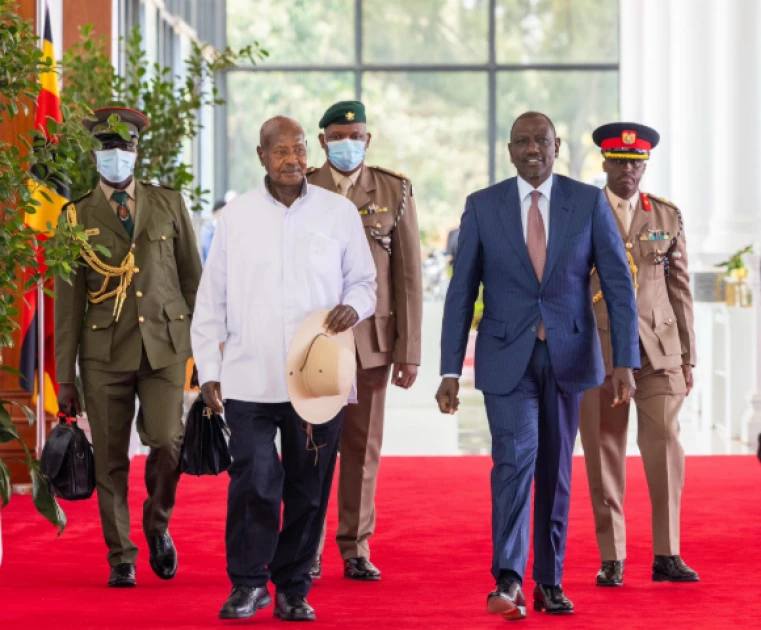
The strategic partnership between Kenya’s William Ruto and Uganda’s Yoweri Museveni, cemented by Ruto’s swift post-election endorsement, is more than a bilateral affair. It is a seismic event that sends ripples across the entire East African Community (EAC) and the Great Lakes region. This alliance between the economic hub (Kenya) and the geographic and demographic anchor (Uganda) creates a powerful new axis of influence. But what does this mean for neighboring Tanzania, the fragile Democratic Republic of Congo (DRC), or ambitious Rwanda? This final analysis in our series explores the domino effect, identifying the potential winners, the nations that must adapt, and the profound implications for the dream of a fully integrated, peaceful, and prosperous East Africa.”
Body: The Regional Ripple Effect Analysis (≈700 words)
H2: The New “Northern Corridor” Power Bloc: Implications for Tanzania
Analyze the reaction and position of the EAC’s other heavyweight.
Tanzania’s Calculated Response: Expect a more muted, wait-and-see approach from President Samia Suluhu Hassan, focusing on strengthening Tanzania’s Central Corridor (Dar es Salaam port) as a competitive alternative to Kenya’s Mombasa port.
The Infrastructure Race Intensifies: The Kenya-Uganda SGR push may accelerate Tanzania’s own SGR plans, potentially funded by different international partners (e.g., China vs. a mix of Western/Turkish funding), leading to a regional infrastructure rivalry.
A Potential Tripartite Balance: The alliance could push Tanzania closer to other partners like Rwanda or Burundi, leading not to fragmentation but to a complex balance-of-power within the EAC.
H2: The Great Lakes Equation: Stabilizer or Disruptor for DRC and Rwanda?
Focus on the security dimension to the west.
For the DRC (A New Member): A united Kenya-Uganda front could be a double-edged sword. It may provide more coherent EAC mediation in the east but could also be perceived as a powerful bloc exerting influence over its affairs.
For Rwanda: President Kagame, who has a complex relationship with Museveni, may view this strengthened axis with caution. It could incentivize Rwanda to deepen its own strategic ties with Tanzania and the Gulf nations to maintain its leverage.
Security Coordination: Could a more unified Kenya-Uganda position lead to more effective joint military or diplomatic initiatives in Eastern DRC, or create new tensions?
H2: The Economic Winners and Losers Across the Region
Break down the tangible business and trade impacts.
Winners:
Logistics & Transport Companies aligned with the Northern Corridor.
Kenyan Manufacturers if non-tariff barriers into Uganda truly fall.
Multinationals seeking a stable, large, two-country market for investment.
Losers & Challenged:
Tanzanian Port Authority faces stiffer competition for transit goods.
South Sudan & Ethiopia: May feel pressured to align with this bloc for access, potentially at the cost of some negotiating power.
Local Industries in Uganda that rely on protectionist policies may face pressure from cheaper Kenyan imports.
H2: The Future of the East African Community: Integration by Bloc?
This is the core speculative and forward-thinking section.
Scenario 1: Accelerated Integration: The “Big Two” use their combined weight to break logjams on common tariffs, free movement, and a single currency, dragging the community forward.
Scenario 2: Fractured Integration: The bloc solidifies, causing other members to form sub-groups, leading to a “multi-speed EAC” where integration happens in clusters rather than as a whole.
Scenario 3: Status Quo: The alliance simply manages bilateral issues better but doesn’t radically alter the slow, consensus-based pace of EAC integration.
H2: The Wildcard: How External Powers Will React
Briefly place the region in a global context.
China: Will it continue to fund all competing infrastructure projects, or will it back the most cohesive bloc?
The West (US, EU): Will they engage with the Ruto-Museveni axis as the primary regional interlocutors, especially on security (Somalia, DRC), despite democratic concerns?
Middle East (UAE, Qatar): Their economic interests in ports and logistics may align more with one corridor over another, influencing their diplomatic engagements.
Conclusion & Visionary Call to Action (≈150 words)
End the series on a forward-looking, engaging note.
“The Ruto-Museveni pact has recalibrated the East African compass. It promises efficiency and clout but also brings the risks of new rivalries and a divided community. The ultimate test will be whether this axis acts as an engine for collective regional prosperity or becomes a vehicle for narrow national interests dressed in integrationist clothing. The next five years will be definitive. We will be here to track every development. This concludes our three-part series. Missed the first parts? Catch up on the initial news and our deep strategic analysis. To ensure you never miss an insight into Africa’s evolving story, become a premium subscriber for exclusive long-form reports and interactive maps. We want your prediction: Vote in our online poll—Will this alliance Speed Up or Slow Down East African integration? Debate, share, and let’s shape the narrative together.”